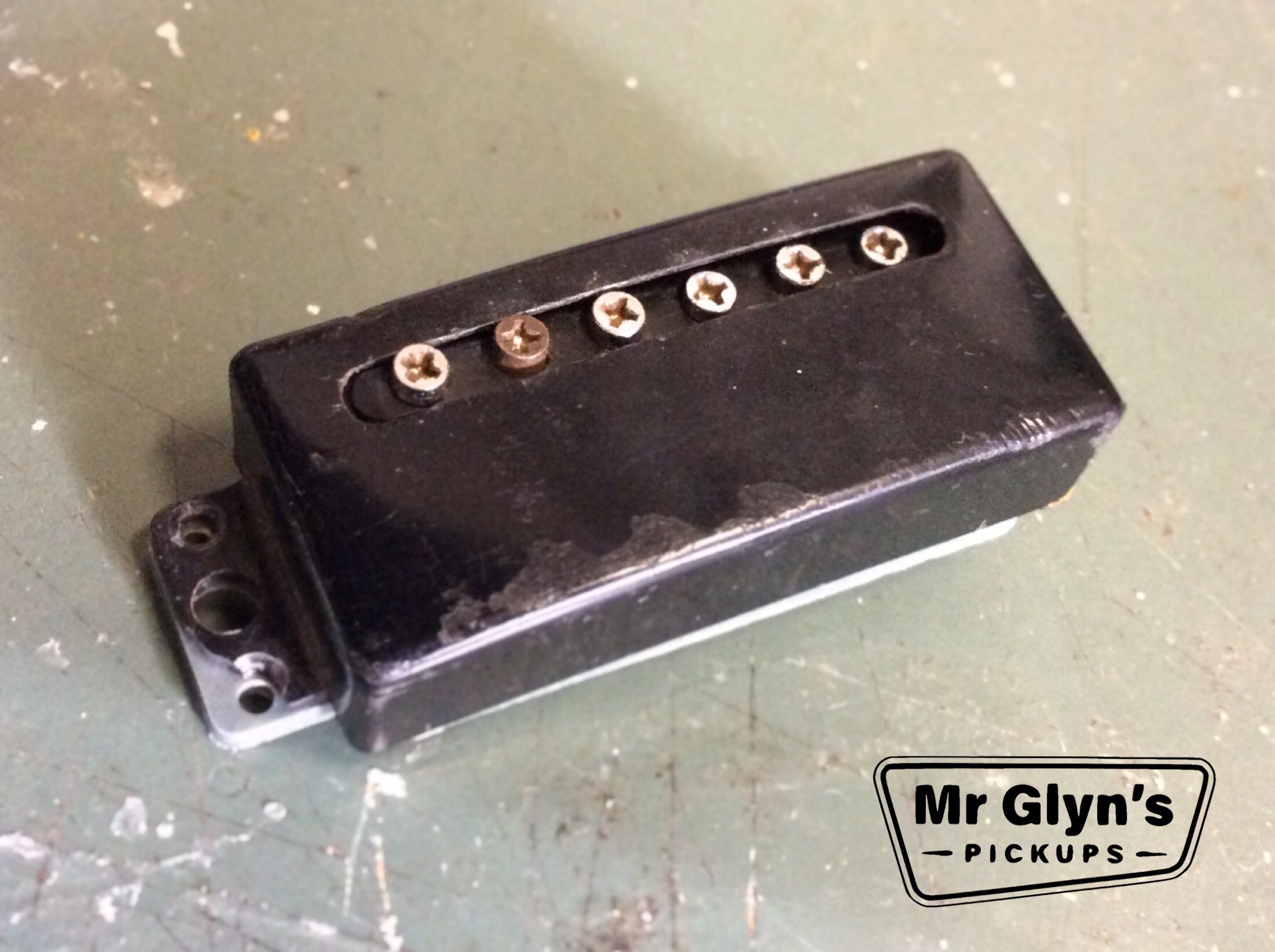
The ’72 Fender Mustang Bass Pickup may appear to be a budget model but Leo Fender cared about his products and everything was thoroughly thought out.
Table of Contents
A bit of history
I get to repair old pickups as well as make new ones so when I was sent this old Mustang Bass Pickup I thought it was worth taking a few pics and writing about it.
This was the last bass designed by Leo Fender before he sold Fender to CBS in ’65. This pickup shows all the thought and consideration you would expect from the great man. It’s easy to dismiss pickups on ‘budget’ guitars but there’s a lot more to this one than meets the eye.
The later version of this instrument, the Musicmaster Bass had a single coil pickup straight out of a Stratocaster – yes really. Here is more on the Musicmaster bass pickup. I make my own version of the Musicmaster bass pickup in two flavours.
The original Mustang bass pickup that I have here is a split pair, like a precision bass pickup but with a few essential design differences.
What makes the Mustang Bass Pickup great
The obvious thing is that it’s smaller, but there’s a good reason for that.
The Mustang is a short scale bass, 30″. With a shorter scale comes less string tension and a much boomier sound with less percussive highs and a fatter bottom end.
So why didn’t he just use P Bass pickup?
It’s obvious from the design of the Mustang Bass Pickup that the intention was not to just knock out a cheap student model but to make a great instrument only with a shorter scale.
You can see that the magnets are protruding out of the bottom of the base plate – they’re 24mm long alnico 5 magnets. P Bass magnets are around half that length. Bigger magnets means more pull on the string and more punch to the attack of the note.
The distance between top and bottom plates is greater on the Mustang than the P Bass. This gives a much taller pickup. With a taller pickup more of the windings are closer to the magnet. A P Bass’ windings can get a lot further away from that magnetic field by the time you get to the outside turns.
Windings closer to the magnet gives a sharper, more percussive mote than the mellower P Bass.
With roughly the same turn count between P Bass and mustang this means the Mustang’s footprint is smaller.
Both those factors – coil geometry and magnetic pull are specifically designed to offset the lack of definition you can hear in a short scale bass.
This was not the easiest path to take. The magnets would have to have been specially made and the flatwork (top and bottom plates) would have been made specifically for this model. Not least there would have been molds made to injection mold the covers.
It was all about getting the best possible sound from a short scale bass while make the price accessible to more musicians.
It’s a clever design.
Five years later when CBS were running Fender they introduced the same bass but with a Stratocaster (yes, 6 pole) pickup. Now that was taking the easy route. Leo Fender always did things the best way he could, working up to a standard rather than down to a price.
If you’re interested in Leo Fender read Forrest White’s book, he was there.
So back to the Mustang Bass Pickup repair
As you can see from the colour of the windings the wire has plain enamel insulation. The insulation does make a difference. Not all insulation is the same thickness. Thicker insulation means windings are further away from each other. This changes the pickups capacitance and to an extent inductance and dc resistance. Remember, we’re multiplying small differences by how many turns there are, in this case over 10,000.
It appears this coil failed due to corrosion of the magnetic pole
You can see the corrosion in this pic.
In the 70’s Fender pickups were potted in lacquer rather than wax in both earlier and later periods. The lacquer didn’t penetrate all the way to the core of the pickup and this is the result.
Before I re-wound this coil it was rust proofed and insulated – I want this repair to outlive me.
Enjoy this? You may also like…
Musicmaster Bass PickupPrecision BassSassy – traditional P90
Guitar Repair Services in Australia is an up to date list of guitar repairers, luthiers and guitar tech services in Australia.
A lot of Mr Glyn’s Pickups go to Australia. I have compiled this list of guitar repairers aka luthier in Australia to help my Aussie customers find a good guitar tech to fit their new pickups.
But also if you need a guitar set up, a re fret, guitar wiring or any other luthier service this list will be of help.
If you have any information on a repairer or guitar tech or luthier in your area or you are a guitar repairer please get in touch. I will add them to the list.
I have primarily compiled this list as a resource for my customers but it is a useful list for any guitar player in need of help.
Please feel free to share this list if you think it may be useful to other players.
It isn’t easy finding a good repairer and hopefully this list gives you a few options.
I was a full time guitar repairer for 25 years in both the UK and New Zealand. I have seen a lot of guitars and helped very many guitar players. A big part of the process is communication, don’t expect your guitar tech to be able to read your mind. Do your best to articulate what you need. Once they have done a couple of jobs for you they will know what you like and the process will become easier for both parties.
Some jobs take time, they just do. Sometimes urgent jobs come in for touring bands, sometimes people get sick. Please be patient with your guitar tech, they want the job finished and get it out of the door too.
Please feel free to share this post far and wide on your social media. Let’s all help to promote guitar repairers across Australia and New Zealand. They deserve our support.
I once saw a sign in a guitar repair workshop that said- “We charge $100/hour for guitar repairs, $120/hour if you want to watch, $150/hour if you want to help”.
The Playmaker humbucker set is a clear sounding guitar pickup set made for genres from classic rock to heavy blues.
Designed for its dynamics, this humbucker set reacts to your playing style and volume settings. They clean up when you back off. They give you the grit you’re looking for when you dig in. The perfect pickup for classic rock or dirty blues. Whether you’re pushing an amp, using pedals or using amp modeling.
Table of Contents
The Playmaker was designed for players who need a guitar pickup with a little more than a PAF. But without being an over the top rock pickup set. They have a little more power and bite than a traditional PAF. The Playmaker’s dynamics and touch sensitivity help you stand out from the mix.
A big part of the testing process involved playing through various classic overdrive pedals as well as amplifiers. Both neck and bridge pickups had to work well with a Tube Screamer, Klon, Blues Driver and fuzz. Not to forget amp modelling, it’s a big part of modern playing.
Here Warren Mendonsa shows the dynamics of the pickups change when he uses the volume controls. The Playmakers respond to his pick attack, that creates huge possibilities for varying your tone and feel. Back off and the Playmaker backs off with you. Dig in and they sing.
Playmaker bridge pickup
The Playmaker bridge pickup was designed with pedals in mind. A part of the testing process was about voicing these pickups to be used with various overdrives. Tube Screamer, Klon and Blues Driver as well as natural amp overdrive were all used as test sounds.
Overdrive stacking is a big part of a lot of player’s sound. The Playmaker set was tested with this in mind.
The bridge pickup is wound asymmetrically and powered by an alnico IV magnet. This gives it better tonal balance than the slightly scooped alnico V magnet. But there’s more power than the alnico II in a PAF. The alnico IV delivers just the right amount of power. It is designed to respond well to variations in pick attack giving the dynamics that blues players need. It maintains its transparency and clarity when using the guitar volume giving you great onboard control.
Playmaker neck pickup
The neck pickup is also wound asymmetrically and uses an alnico 2 magnet to maintain a mid range balance.
The reason for the asymmetry is to give greater mid range clarity and that neck pickup chime. It loves clean funky rhythm lines as well as singing leads. This is a neck pickup that wants to be played, not just an ornament. It’s great for rhythm parts that stand out in a mix. But it’s not shy if you’re having a Gary Moore or Santana moment.
Here’s another example of the bridge and neck pickups.
Here is a short video showing some of my thoughts on the Playmaker and how they sound.
The Development of the Playmaker humbucker set
The idea behind this pickup came originally from Ben Sargent. He’s a well respected guitar repairer in Wellington NZ. He has fitted many sets of my pickups as well as using them himself.
He called me in late 2024 with an idea. He’d been thinking I should make a pickup between my Integrity PAF range and the Cloud Nine rock pickup set. Something that would react to changes in the player’s attack. A humbucker set that would be equally happy played clean or dirty.
It seemed like a great idea. We agreed it needed to be something different, not just an over wound PAF. So that summer the idea was churning around in my head.
Spending time thinking can often be more productive than time spent winding coils.
In February 2025 I got down to work making prototypes. As for all my pickups when I felt I was close I swapped the pickups into different guitars. Testing with various scale lengths and body woods is essential. I need to hear them in different situations.
I tested them with many different amps and overdrive pedals and with the band. At that time the band was auditioning for a new drummer. It was the perfect environment to try the pickups in different situations. The drummer makes a big difference to how the pickup’s low end responds in a mix. Within a month I got to test them with 2 different bass players and a half a dozen drummers. Its important to play next to a drummer and bass player. You just don’t know how a pickup will react until its up loud in a mix.
Playing live is an essential part of my testing. That is when you hear how the bottom end sits in a mix. It is easy to make a pickup too boomy. It is only in a band situation that you really know how it sits. A lot of makers skip this stage. It certainly makes the design process longer but I intend to use this design for the rest of my life. I don’t care how long the prototyping stage takes, it needs to be right.
When I was happy I sent a set down to Ben in Wellington to get his take on them. He’s a very different player to me so his contribution really mattered. He was happy with them – so I was too.
These pickups are happiest with 500k Ohm volume and tone pots and 50’s style wiring in Gibson type guitars. The choice of capacitor is up to you but I like 0.022microfarad. Great with either modern wiring or 50’s wiring though my preference is 50’s.
The bridge pickup is great in HSS Strats alongside either my Kokako or Tui single coils. The neck pickup is ideal as a neck humbucker with my Cruel Mistress or Duchess bridge pickups.
To celebrate NZ Music Month in May ’25 I recorded a riff every day for a month. Every riff was from a New Zealand artist. and they were all recorded using a Playmaker set in a Les Paul. I wanted to show the versatility of this pickup set. Here are all 31 riffs. I think you’ll agree this set of pickups will do just about anything you ask of them.
Cover options
Here are some options for the look of your new pickups.
Don’t forget, if you want your pickups aged you just have to ask. I’ll ask you for some pictures and do my best to match the ageing of your guitar. Here is some more info on guitar pickup ageing.
The Warwolf is a brutal, hard hitting guitar pickup set designed for extreme metal in drop tunings.
Immediate, punchy bass, smooth mids with plenty of character and a present top end give these pickups the ability to cut through the mix no matter how low your tuning. The combination of brutality and clarity make the Warwolf essential both on stage and in the studio.
The bridge humbucker has the bite and grunt to power your riffs and bring them out in the mix. The neck humbucker has a bell like clarity perfect for clean passages or fat lead tones.
There is plenty of power to push the front end of a 5150 but with a frequency response to work with amp modeling.
Table of Contents
The Warwolf doesn’t have the spec you might expect from a powerful pickup but this has been a re-think of the requirements of pickups for metal guitar and a re-working of what is actually needed to produce a crushing tone in both sound and feel.
At the beginning of the process I had assumed I needed coils with high dc resistance but I discovered that was not the case. To get the maximum punch, clarity and dynamics this pickup has a lower powered coil but big magnets. The coils produce clarity and a balanced frequency range. Big magnets give a big punch. It’s all about the immediacy of the note. To achieve that brutal feel the note needs to start and stop instantly, that comes from the magnets.
Warwolf
The Concept
The oversized ceramic magnets in the bridge pickup are asymmetrically mounted to emphasize one coil over another, the idea is to reduce the magnetic window to give the pickup character and focus.
The neck pickup has a more conventional magnetic symmetry.
Although this style of guitar pickup needs a certain amount of power that is not the whole story. Without clarity and punch itโs worthless. Ceramic magnets give a dryer, more immediate attack than alnico. We donโt want a warm smooth, soggy bass – it needs to react instantly, have an immediate kick.
Ceramic can be guilty of sounding scooped but with the coils providing mid range thereโs a balance. The treble is present but not harsh. The winding method provides clarity- itโs all about clarity.
Sound Sample
Here is the Warwolf in a mix:
Warwolf in a mix
And the guitar tracks isolated:
Guitar Isolated
The Design
Here is the design concept of both neck and bridge pickups described in my own words:
The Backstory
The design of this pickup set started back in August 2020 when I approached Raj Singarajah from Dynamic Rage Studio to be the ‘test pilot’ for this project. Some musical genres need expert ears and I knew I needed someone with taste and experience to steer my designs.
After about 6 months of prototypes we had what we were after. That time taught me a lot about designing pickups for this extremely demanding style. It was then that I realized that I had to manufacture so many difficult parts for this particular pickup that is just wasn’t going to be practical for me to make in any quantity. The project got put on hold. But I had learnt a lot about what a pickup was required to do to work in this very difficult environment.
Then at the beginning of 2022 I was contacted by New Zealand band Alien Weaponry to make a signature pickup for guitarist Lewis DeJong. I thought this was where I could use my design ideas. But one of the design requirements for Lewisโ pickup was it needed to have a sound similar to their last album so they could tour with it. My ideas about lower impedance werenโt going to work. Lewisโ set up is old school using Marshall heads powering 4×12โs so I took a more traditional approach to his pickup. You can find out more about the signature pickup for Lewis DeJong from Alien Weaponry here.
The idea for my extreme metal pickup was still churning around in my head but I needed help to get it off the ground.
Then in July 2024 I saw a post on Facebook by Richie Simpson. Richie is an award winning artist and producer of New Way Home and City of Souls. He had been a customer of mine when I was repairing guitars. I remembered he had been for ever swapping pickups in his many guitars searching for a tone.
He had experience of all the metal pickups out there, he’s a great player, knows this genre intimately and is a top human being. So I messaged him and he said yes. There followed a long phone conversation to establish what the brief was. It really felt we were on the same page.
A week later I was at his studio with a guitar loaded with the first prototypes. I was quite prepared for these first pickups to be a total failure, I just needed to sound him out. I needed to find out what sound was in his head and the best way to do that was to have an example with me. But I also wanted my idea to work.
When I got to his studio Richie was tracking guitars. We listened to one of his guitars with a โboutiqueโ pickup in the bridge position, then plugged in the Warwolf to A/B. I could tell from his face he was โfeeling itโ.
The neck pickup was right first time and the bridge was close. Iโd won round 1 on clarity and punch. It turned out that was his #2 guitar.
So now for the #1.
It was pretty obvious this was no longer just a concept- this was the real thing.
He kept that guitar for a week to get a feel for it and to make sure it was exactly right. It was close but not quite there. We had a chat, I made another.
Then he came to my workshop and I fitted a set into one of his guitars to see how that worked.
A week later we talked. He was completely happy with the neck pickup but the bridge needed more mids. That’s how it proceeded for a few months.
I tweaked the design. Time passed and he wanted that pickup in his number one guitar just to eliminate the difference in the guitar bodies.
Whenever I collaborate with a player Iโm very aware that each guitar sounds different. My test guitar for this genre is a very neutral sounding basswood body 25.5 inch scale LTD guitar. Itโs got a very even frequency response so ideal for testing.
The plan is to get the pickups sounding good in this guitar and then transfer them to the playerโs guitar to compare.
The body wood does make a difference – I find it unbelievable that debate is still going on. I swap a lot of pickups and the guitar theyโre going into matters, I wish it didnโt. Just listen to two electric guitars played acoustically, thatโs the sound the pickups are hearing.
A Player’s Perspective
Here it is in Richie’s words:
August 2024
The Warwolf is much more than your average over compressed, one dimensional metal pickup. Through a fastidious back and forth phase over the course of 6 months, using multiple guitars and amps, a balance was struck.
The brief: “Classic, punchy nineties heavy tone. Attack, tightness, aggression and detail while retaining balance, bloom, string separation and weight to chords. Ideal for alternative or groove metal, thrash and heavy rock.
If mid nineties Jerry Cantrell, Steph Carpenter and Dimebag Darrell had a baby with Terry Date”
Using more robust rails and larger powerful ceramic magnets has allowed for a more open wind while still maintaining the snap and mid range aggression required for heavy music. Avoiding the brittle harshness often associated with ceramic rails.
The Warwolf punches when it chugs, steering away from clanky single coil-esque pick attack and the upper mid bias cliche of many metal pickups. It’s open, organic and balanced nature gives size to a mix, width and note separation to chords under high gain while retaining excellent tightness, a commanding mid range bark and muscular thump during palm muting.
Response to your playing feels natural, without the sense you are fighting with a loose, low output pickup or conversely like the pickup is doing all the driving for you and hiding nuance or preventing clean up. Just enough compression for a mean high gain rhythm tone while still letting your right hand do the talking (Or yelling).
Leads are clear and liquid. Mid gain and clean tones are full and balanced but if you play aggressively, the Warwolf will tear your face right off and drop it back at your feet.
“This is what I’ve been after for a LONG time”.
When you bend a note on these pickups you don’t get strings dropping out as they pass over different bobbins, or if other strings are ringing out they’re not cutting through the bending string signal and vice versa. That’s the beauty of Glyn’s rail design.
The magnetic field is balanced more evenly across the strings and that opens a lot of doors to ideas that might only translate with this kind of pickup. The Warwolf design does something to the mid range that I really dig too. Like a harmonic overtone smearing that is really pleasing for heavy riffs. With each strings signal being represented in a more evenly powered way you can almost get the feel of a boost pedal or active pickup while retaining the more expressive dynamic range of a passive.
That feel responds well to a boost pedal if you are so inclined and doesn’t squish out or lose definition like a super hot pickup can.
I genuinely love how these things feel and sound. They’re unique and alive, translate well to a mix and most importantly they make me want to play! (Not to mention they look cool as hell) Glyn has absolutely nailed it.”
The Warwolf name
Itโs always hard choosing a name but this one comes with a story.
I wanted a name that would represent a heavy crushing force, something fearful and powerful.
The Warwolf was the largest trebuchet ever made. It was built in 1304 for king Edward I of England during the siege of Stirling Castle in Scotland.
It took so long to build that the siege was over by the time it was completed. He used it anyway.
The Blue 90 is a dynamic, clear, balanced P90 pickup set. It has a little less low end push than a traditional P90 but with clearer highs. They’re designed for the player wanting a clean sounding P90 tone but with the ability to push an amp when asked. Ideal for clean tones, jazz, funk and blues.
Table of Contents
Blue 90 Tone
The phrase ‘fat single coil’ is really the essence of this pickup set. They have a full, chiming tone but with the dynamics of a true single coil pickup. They have that distinctive P90 tone but with more clarity. If you ask them they will push your amp into overdrive but less than my Sassy P90 set. They have the magnetic and coil geometry of a P90 but the under wound coil gives a clearer, more dynamic tone.
The Concept
I had been thinking for a while about making another P90 set. Something a little less powerful than the Sassy P90 pickup but with more sparkle than the smooth Cool 90 pickup.
I had experimented a little with under winding the Sassy and really liked the results. I liked the dynamics and how well it worked with modulation effects and delays giving a well balanced platform for these effects to shine. With my prototypes I had reduced the lower mid range ‘clonk’ that traditional P90’s have. It seemed like a pickup with a definite place in then World..
It felt to me like a very useful set of tones and I needed to investigate more. Like with many designs I hadnโt done much about it other than making a prototype, playing around with it, taking it to a gig to hear it next to a drummer and leaving it at that. I always liked this design, I just didnโt get around to putting them up for sale.
The Blue 90 story
Then in September 2024 I received a phone call from guitarist Nick Granville.
Nick has a few of my pickups in various guitars and I have huge admiration for his playing. He knows guitars and he knows tone.
The reason he called was that he had a problem with a P90 loaded guitar (not my P90’s). He wanted a cleaner P90 tone.
Like many pro players he’s very good at describing sound and his requirements. I felt my Sassy P90 set might be a bit grunty for him so after a little think I decided my new P90 idea might suit his needs.
For me this is a great situation where I get to borrow the ears of a top pro player to test out a new pickup. Although I had done a lot of testing myself already I knew that if Nick liked these pickups it would push it over the line and I’d have a new model. I always have prototypes on the go, sometimes it just needs a nudge.
I wound a set, sent them to him and a few days later got a message which read:
“They really do sound good. Have a nice sparkle but still sound like P90โs, and enough push to get it driving enough and vintage in vibe. I like them a lot.”
So that was it, a new pickup set was born. Iโm very pleased to welcome this new P90 set to my website.
Available in dogear or Soapbar, black or cream. If youโre ordering Dogear (or even if you arenโt) Iโm happy to send you a 3D printing file for height shims.
I was contacted by a customer recently wanting a 2 string pickup. Was it for a 2 string guitar? Maybe some other instrument…
Table of Contents
Why would you want a 2 string guitar pickup?
The idea behind this pickup is for it to be mounted to a conventional electric guitar for it to just ‘hear’ the E and A strings. Then that signal is sent out separately from the main guitar pickups and put through a pedal to lower it an octave. The octave down sound can be amplified separately or combined with the signal from the 6 string pickups. It’s one of those ideas that the more you think about it the more uses you find for it.
I came across this idea before back in 2014. Here is a blog post on 2 string pickups I wrote back then. The ones I made then were a little different. One was for a bouzouki and another for an acoustic guitar. The overall idea was the same. The idea is to only hear one or two strings and to lower the signal by an octave.
Design
I had a lot of questions for the customer. In the end I concluded the pure signal from a single coil pickup was needed. And that pick guard mounted mounting would be best.
So I got on the computer and designed what was essentially a cut down Strat pickup.
2 String CAD drawing
My plan was to design the pickup using a CAD program and then laser cut the top and bottom plates. It is constructed the same way as a Fender.
The advantages of using a laser cutter are simply accuracy and repeatability. The customer wanted 2 pickups and, well, I have been asked before, maybe I will again. Spending time on the CAD drawing means I’ll only have to do this once, next time it will be a lot easier.
Laser cutting
Pickup Construction
The bobbins have a top and bottom plate laser cut from Forbon (like a Fender) and held together with the magnets. I have my magnets specially made for me, these are the two middle magnets from ‘Tui’ pickup. As extra security I always super glue the magnets and flatwork together as well as insulate the magnets from the windings – I want to be sure. I haven’t shown that in this picture.
bobbins
I chose the Tui design and winding count because of its strong clear signal. The bass strings need to have a big clear chime if they’re going to be lowered an octave. I don’t want them to sound mushy or undefined.
Once they were wound I potted them in hot wax to prevent micro-phonic feedback. It’s turning out to be a really cute little 2 String Pickup.
The finished pickup
I did consider designing and 3D printing a cover for this 2 string pickup. I think it will be something I’ll do in future but there isn’t the budget for that this time. To finish the pickup off after wiring it up I taped the coil for protection. It’s ended up looking more like a mini Tele bridge pickup.
And there’s the perfect space on the bottom for one of my stickers.
A few weeks later I received an email from the customer saying – “It’s sounding great – I’m noticing much better string isolation then what I was getting with the cheap cigar box pup”.
He included this picture of his rather cool looking guitar:
2 String Pickup
If you have a project in mind please get in touch. I’m not always going to say yes but sometimes I do.
Pickup Height
The base plate is designed with the intention of a pick guard mounting like in a Strat type guitar. There is always going to be some modifying needed to fit this pickup.
Remember, you’re aiming at a pickup height of 2mm. That’s from the top of the magnet to the underside of the string. That measurement is taken when fretting the last fret.
This diagram should help:
Measuring Pickup Height
That measurement is not super critical but you need to be close. If the pickup is too far away you will not get a strong, clear signal.
From its humble beginnings the Musicmaster Bass has become a classic. Beloved of Indie bands, studio engineers and offset fans. The Musicmaster Bass has begun to make its way in the world and leave its mark on music.
Table of Contents
Musicmaster Bass Pickup
The Problem with the Musicmaster Bass Pickup
Designed originally to be a โstudent modelโ short scale, Fender cut quite a few corners to reduce the cost. This was the 1970โs and the accountants had a big say at Fender. This was an instrument made down to a price not up to a standard. But despite the obvious cost cutting I still have a soft spot for the Musicmaster. They were cheap but that doesnโt mean they werenโt good.
The basic bones of the Musicmaster are good. Short scale bass with a small body makes a lot of sense. But there was a problem with the pickup.
Rather than design a pickup specifically for this guitar Fender instead used a Stratocaster. Then they hid it inside a blank cover.
Here is the problem with using a Stratocaster pickup with a 4 string bass. The red lines are the strings and the black dots are the pickup magnets.
Itโs pretty obvious that the magnetic pole pieces just donโt line up with the middle strings.
The pickup wasnโt visible under that blank cover and they decided it didnโt matter on a budget bass anyway. So thatโs how it was.
The Solution
In July 2024 I was contacted by my Neville Claughton from Nelson. He had an original โ73 in need of a new pickup.
Nev is a legend in NZ, heโs been well known in the music business for ever and I have huge respect for him.
His request got me thinking so I decided to make my own version of the Musicmaster pickup but with 4 poles that line up with the strings.
I got on the computer and designed this pickup flatwork to be laser cut. As you can see itโs simply a 4 pole Strat pickup.
The only difference is those pole pieces.
And here is the spacing of the poles on the Mr Glynโs Pickup. You can see how the magnets line up with the strings.
Iโm happy with that.
Winding the Musicmaster Bass Pickup
So how was I going to wind this pickup?
Thereโs nothing wrong with the windings of a โ70โs Strat pickup. With the reduced string tension of a 30inch scale bass there is a tendency for it to get boomy, so having a pickup with less inherent bottom end can help with clarity. It really isn’t a bad sound. My personal preference for these instruments is to have the Strat pickup specifications but with, of course, the correct string spacing.
But there is scope for having different winding options.
If you want more fatness in your tone I also offer this pickup with my โ51 Telecaster Bass wind. This gives a bit more power but also more bass. This option still has the same Strat footprint and fits inside the same cover.
Strat Wiring must be the most modded wiring of all. It’s not that the original wiring isn’t great, there are just so many other possibilities. When I worked as a guitar repairer I re-wired a lot of Stratocasters. There are so many options, so many things that can be changed. A lot of players have their favourite versions of wiring up these fantastic guitars.
Table of Contents
What I did find when I as modifying other peoples guitars is they would often come back to something close to standard wiring in the end. After trying multiple switching in every combination, series, parallel, coil tapping, humbuckers … it goes on, they often returned their Strat so something very close to the way Leo Fender originally did it back in 1954. There is a lot to be said in favour of simplicity.
Here I’m simply going to show you the standard way of wiring a Strat and add one simple and useful modification – that cheeky little red wire. I can’t recall ever being asked to remove this modification to a Strat’s wiring, there’s simply no disadvantage.
Here is the diagram using the colour code for my own single coil pickups.
Strat Wiring Diagram
Strat Wiring
How Strat controls work
The heart of Stratocasters is the 5 way switch. Interestingly it wasn’t until 1977 that Fender fitted them as standard. Before that it was a 3 way switch and players had to ‘balance’ it between 2 positions to get that famous in between Strat tone. We’ve got it easy these days. Position 2 or 4 on a 5 way is such an iconic Stratocaster sound – you can spot it anywhere.
Here is a Stratocaster control plate. It looks straightforward but why are there 2 tone controls? Must be treble and bass yeah? Well no, it’s a bit more complicated than that. This is a passive system (no battery) so the tones just cut treble giving your sound less highs, they can’t boost bass. The middle knob marked tone is the control for the neck pickup and the end one for the middle pickup.
With the switch in the position shown the neck pickup is selected and the middle knob acts as a tone. If this 5 way switch was 2 clicks on it would select just the middle pickup and the end tone know would be engaged.So you can pre-set a tone setting for a pickup. I guess it was considered a step up from the Telecaster’s single tone control for the whole guitar.
Strat controls
That’s great but it means with a standard stratocaster there is no tone control for the bridge pickup. If ever there was a pickup that needed a bit less treble its the strat bridge pickup. If you refer back to the wiring diagram you can see a little red wire on the switch connecting 2 legs together. Adding that little wire with mean that the tone control for the middle pickup will also work for the bridge pickup.
It’s the simplest of all Strat Wiring mods but a very useful one and a good place to start if you’re new to experimenting with wiring.
What is SSS, HSS and HSH?
SSS – means 2 single coil pickups so a simply a standard Strat configuration.
HSS – That’s a Strat but with a humbucker (H) in the bridge position. The reason you might want a humbucker is for a fatter bridge pickup sound. Standard Strat bridge pickups can sound a bit weedy. All the Strat bridge pickups I make have a little bit more power to offset this but a humbucker may well suit you better anyway. This makes for a very versatile guitar but retaining the simplicity of the original design. On stage there is so much going on that complicated switching options can often work against you.
HSH – You’ve guessed it – there’s a humbucker in the neck and bridge positions. This is often used with coil tapping. The idea is to have both Gibson and Fender sounds in one guitar. Usually positions 1 and 5 of the switch will give either bridge or neck humbucker on their own. Positions 2, 3 and 4 will be combinations of the middle single coil pickup and the humbucker with 1 coil switched off (coil tapping) or series/parallel etc. There are so many options and combinations possible and some spectacularly complicated wiring to figure out to make it work.
For some of the more complicated wiring options the conventional 5 way switch just isn’t enough. There is a type of switch commonly called a ‘super switch’ that gives these extra options. It looks the same from the outside and is the same to operate but under the hood there’s a lot more going on. This switch allows you to wire up just about all the options imaginable. Maybe I’ll write more about them some other time.
Do I turn it all up full?
A lot of players do but I feel they’re missing out on a lot of tones. Try backing off the volume and tone to about 8 and setting the amp sound to that. It really is worth trying it. As you turn the volume down your sound looses a little treble. This can really smooth things out and give you an easier tone to work with. With your volume at 8 you also have somewhere to go if you need that bit extra for a big solo.
Now I’m at the end of this blog I realise there are a lot more diagrams to draw and a lot of wiring options to discuss. Not just for Strats, there are modifications that can be done on any guitar.
You often come across the terms HSS in reference to guitar pickups but what does HSS mean? And while we’re at it, What do HSH and SSS mean too?
Itโs all about the pickup configuration in a guitar (usually a Strat style guitar).
Put simply it means Humbucker, Single coil, Single coil and refers to the pickup configuration in an electric guitar.
Traditionally Stratocasters had 3 single coil pickups SSS – single, single, single. But there are other options – replacing the bridge pickup for a humbucker – HSS, humbucker, single, single. Or replacing both bridge and neck for humbuckers – HSH, humbucker, single, humbucker. I’m sure you get the point.
Table of Contents
Why would you want a bridge humbucker?
Surely Fender know what theyโre doing so why mess with it?
Well, the Stratocaster first went into production in 1954 and has barely changed since. Although the guitar is the same, music certainly isnโt. Changing the bridge pickup for a humbucker can give you way more options.
HSS Strat
What is the difference between humbucker and single coil tone?
Humbuckers are generally more powerful and have a fuller tone. They will push an amplifier into overdrive more easily. The humbucker sound is fatter and less percussive.
This is a great configuration but for rock players the bridge pickup can be a bit thin and weedy sounding.
There is a place for every tone but a lot of players do prefer having a bit more power in the bridge position.
SSS Strat
What’s the solution?
With the advent of replacement pickups players started fitting humbuckers in the bridge position. It can involve some routing (not always) but it really fattens up that bridge position sound. The HSS (humbucker, single, single) Strat was born.
HSS guitars are hugely versatile. You get the best of both worlds. All the lovely clean single coil tones but with a fat lead tone when you need it. Itโs like combining a Strat with a Les Paul and can really open up possibilities.
By now youโve guessed HSH – humbucker, single, humbucker . This is another hugely versatile set up but weโre getting further away from the original Strat tones here. This is really popular with rock players from the. 1980โs on. The neck position humbucker gives those lush thick fat lead tones associated with Gibsons – think โStill Got The Bluesโ.
HSH
With all these extra tonal options come more wiring possibilities. Humbuckers have 2 coils. That gives the option to have those coils wired in series (conventional humbucker) or in parallel- similar to a single coil tone.
Thereโs also the option of coil tap where one of the 2 coils is turned off.
How those wiring options sounds is going to be the subject of another blog/video.
What is a swimming pool route?
If you have a conventional Strat type guitar it does require a bit of woodworking to fit a humbucker at the bridge position.
Here is what a Strat looks like under the pickguard. As you can see a humbucker won’t fit in that small cavity.
SSS Strat Body
But some Strats have what is known as a swimming pool route. With this type of body any pickup configuration will fit. SSS, HSS, HSH, you just need to change the pickguard. It looks like this:
Swimming Pool Route
There is a school of thought though that this ruins the sound of a Stratocaster. I’m not getting into that discussion here.
So What does HSS mean?
Well, it’s simply an option for pickups on (usually) a Stratocaster type guitar.
There are so many tonal options with a Strat, so many changes you can make. if you are getting into modifying (modding) guitars then a Strat is a perfect platform for experimenting.
Pickup string spacing is something you need to be aware of when you’re buying guitar pickups, particularly humbuckers. Guitar bridges come with different string widths so pickups need to match that. In this blog post I’m going to explain what It’s all about and how to measure it.
Table of Contents
What is a Pole Piece?
Pickups have pole pieces, think of these as magnets mounted in the pickup listening for string movement. Sometimes they are actual magnets, sometimes pieces of steel directing magnetism towards the strings. In this case they are steel screws.
Humbucker Poles
This is what we mean by ‘pole spacing’ its the distance between the outer most poles, centre to centre.
Humbucker pole spacing
What you don’t need to know
Here’s how a pickup works. A the string sitting inside the magnetic field actually becomes a temporary magnet. When the string vibrates it disturbs this magnetic field. This creates an electrical signal in the coil of wire around the magnet.
It’s a tiny signal but enough to get through your guitar’s on board circuit and down a cable. It’s hard to imagine that such a small amount of electricity can produce such a lot of sound. Have a think about it next time you’re at a big gig. What you’re hearing is just that small amount of electricity generated in a coil of wire. It’s really cool stuff and I find it fascinating. But you don’t really need to know all that.
Pickup String spacing – what you need to know
The string needs to align with the magnet to get the best signal. Magnets are, however, not lasers, they generate a magnetic field and not a precise beam. If the string isn’t in perfect alignment it’s fine. If the slightest misalignment made a difference then string bending would cause a drop in volume. Have a look next time you bend a string how far the string moves away from the pole.
String Alignment
As you can see, a little bit out of line makes no difference. Eddie Van Halen used a vintage PAF on Van Halen I with a Fender type bridge. PAF ‘s were 49.2mm (1 15/16″) spacing and Fender bridges are usually 52mm. If there had been a problem he would have noticed. So don’t get too hung up on this stuff. There are many more tiny details involved in guitar playing that you’ll be much better off worrying about.
Please remember that if a humbucker has 49.2mm spacing or 52mm spacing it’s outer dimensions are the same. The overall size of the pickup doesn’t change. So if you take out a 49.2mm humbucker and replace it with a 52mm it will still fit. It’s just the pole alignment to the strings that will be different.
As the poles can be further away the distance the winding wire travels to get around the bobbing is also longer. A 52mm pole spaced pickup will have a slightly higher Ohm reading than a 49.2mm spaces pickup due to this extra length. It is possible to under wind a longer bobbing to compensate for this but the result is a pickup that sounds thinner. Its the number of turns that is important not the Ohm reading. You don’t really need to know that either but it’s an interesting fact.
Guitar bridges come in various sizes giving different string spacing. A Gibson ABR Tune-o-matic your string spacing will be narrower than a Fender Strat bridge, for instance. It can get confusing when dealing with different Tune-o-Matic bridges. The older style ABR has a narrower spacing than the more modern Nashville bridge. Either could be fitted to a Les Paul. If you’re thinking of buying some Mr Glyn’s pickups and you have any doubt just email me. Yoiu can always send a pic and I’ll tell you which bridge you have.
By the time the strings get to the neck pickup the spacings are just about the same. So neck pickups don’t vary in width. We’re just talking about bridge pickups here.
Ideally we want the strings to line up as best as possible with the pickup’s poles. But we’re not getting too hung up on it.
How to measure string spacing
The measurement is the distance from the first to the sixth strings centre to centre at the bridge pickup. This diagram should help:
Strat Bridge
You can simply do this with a ruler, like I have.
As you can see this ’89 Strat bridge has 52mm string spacing. If you wanted to choose a bridge humbucker to make it a HSS Strat then choose the 52mm option.
If you’re buying a Mr Glyns Pickup and have any doubt just send me a pic of your bridge. I will be able to advise you.
What is F spacing?
F spacing simply means a wider spaced bridge humbucker – 52, 52.5 or 53mm. The F stands for either ‘Fender’ or ‘Floyd Rose’. It isn’t clear which and doesn’t really matter.
Why 49.2mm not just 49mm? You may well ask! It’s the metric equivalent of the pole spacing for a Gibson PAF. That is the pickup most humbuckers are based on. The original measurement in imperial is 1 15/16″ – which if you ask me is no less silly a number that 49.2. But we’re stuck with it.
If you have any questions about which pickup is right for you please get in touch.
Thanks for reading this blog post. Please contact me if there are any pickup based subjects you would like me to write a blog about. I’m always looking for new subjects.
I thought it was going to be a straightforward pickup repair but is this pickup actually a Maxon humbucker?
Table of Contents
As part of my work I repair pickups for luthiers. Most guitar repairers don’t wind pickups and even the ones that do often send me pickups to repair, it saves them a lot of time. One such repairer is Auckland’s Ramsay Phillips.
For me repairing pickups is a really interesting part of my job. I enjoy seeing how the basic concept of a magnet and a coil of wire can be made in so many different ways. Back in the 1990’s I first learned about pickups by repairing them and I don’t think that instinct ever leaves. Most of my pickup repair work is very straight forward but occasionally something interesting comes along. This is one of those.
So Ramsay sent me a bridge humbucker from this 1970’s Antoria to repair. I was expecting something like the classic Maxon U-1000 but there was a surprise.
This is not the first Maxon Humbucker I’ve seen Iโve worked on a few old Maxon pickups in my time and they have always deserved their great reputation. So I had a good idea what to expect from this humbucker.
Maxon serial number dating
The number on the base plate of this pickup is a date stamp not a model number though it would be nice to have both.
So to translate the Maxon pickup dating code:
The first number is a production line code
second number is the year, so in this case 1974
third number, the month, so September
and the last 2 are the day, so the 17th
So that tells us its from Sept 17th 1974. I always wonder why manufacturers can’t just write the date plainly instead of a secret code but they all seem to do it.
Something unusual
But there’s something odd here. The pole piece screws don’t extend under the base plate. The 6 holes in the base where I expected to see the poles are blocked by something. Time to get the cover off and see what’s inside.
What’s Inside?
This is exactly what was inside – a single coil disguised as a humbucker! So Maxon humbucker? Well, it’s a Maxon but not a humbucker.
It has the typical floppy nylon bobbin I would expect to see in a Maxon but this one is sitting on top of a large ceramic magnet.
My job here is to fix this pickup so I remove the bobbin and start to carefully remove the sticky old tape.
I remove the hookup wires and try re-soldering them to the winding wire and the pickup comes to life. It was simply a dry joint. This one is showing me 8KOhms on the meter which is in the ballpark of a PAF though it would sound nothing like one.
You can see the metal plate mounted inside the bobbin that connects the short pole screws to the magnet.
So, Maxon humbucker? Well, certainly Maxon but not a humbucker. Beware – not all Maxon pickups are classics.
I’ve had a look on line and can’t find a model number for this pickup. It seems the only distinguishing feature from the outside is the lack of pole screws through the base plate.
If you are interested in vintage humbucker tones check out the Mr Glyn’s ‘Integrity’ humbucker. It comes in 4 flavours or both bridge and neck.
Draig doom set specifications: Alnico VI โ Bridge 9.38 KOhms, 7.42H, Ceramic 8 – Neck 7.26 KOhms
The Draig doom guitar pickup set is designed for all the genres encompassed by Doom Metal. It has strong mids, smooth treble and a bass response immediate enough to cope with low tunings. This is different from the harsh, dry percussive bass needed for extreme metal. There’s a warmth and clarity. It really is all in the bass and mids.
Table of Contents
The Draig is inspired by the sound of Tony Iommi and that heavy riffing guitar tone, mid forward.
Iommiโs tone has been in my head since I was a teenager, its a huge part of my guitar taste. Iโm delighted to make this pickup available.
As you will hear from listening to the following demos, it’s more than just the Iommi sound. Players have taken this pickup and created their own sounds and feel. That was just the starting point, there’s no telling where it will go.
Power and Tone
But there’s another factor with this pickup. You’ll notice the Ohms for the bridge are in the 9K range, lower that you might expect. But this is still a powerful humbucker. This is all about increasing the dynamics and reducing compression. When using heavy fuzz, it’s really useful to be able to back off using just playing technique; the Draig is designed to do just that. It’s designed to work along with your fuzz no matter how extreme. Whether you’re using just a light fuzz or overdrive or an extreme Big Muff tone the Draig maintains clarity.
The coils are tuned to give the Draig its tonal characteristics with the magnet providing the engine.
Draig in ‘Dragon Breath’
Pickups designed to derive most of their power from the strength of the coil, rather than the magnet, sound smooth, even and compressed like my Attitude humbucker. The Draig bridge gets a lot of power from its oversized alnico 6 magnet. This makes the Draig touch sensitive, dynamic and punchy.
Chrome cover Draig
So why alnico 6 in the Draig doom bridge humbucker?
Alnico 6 has similar properties to the more familiar alnico 5 but with more mids – it’s all about the mids. As you’d imagine, it has a little more power too.
Draig Doom Bridge Humbucker
Draig bridge humbucker
Draig doom bridge humbucker design
It wasn’t an easy pickup to design. It was designed for low tuning but with more of a Doom vibe in mind. Iโve made pickups before for extreme metal and it a very different approach to the bottom end. With extreme metal the bottom needs to be much drier and more immediate and percussive. With the bass on this one Iโve tried to walk the line between over hard and dry on one side and soggy and undefined on the other. I like to think I have found a path in between giving power with clarity.
The choice of magnet was a big part of this. A bigger magnet has a more immediate response than the conventional size and I experimented with a few different types of alnico. I finally settled on alnico 6. This oversized alnico 6 magnet gives all the punch and immediacy I wanted but with slightly stronger mids than alnico 5. Being an unusual size and material, I get these magnets manufactured specifically for this bridge pickup.
Like with many pickups to focus on the winding alone is telling only a small part of the story. The winding is 9.38K Ohms which might seem small but itโs all about balancing the mids. That oversized alnico 6 magnet is where the power comes from. The blade pole pushes more of that magnetic energy to the side of the pickup furthest away from the bridge, lessening the โpingyโ high end. Itโs all about balancing the tone and emphasising the mids. The blade side of the bridge pickup is more efficient, mounting this side furtherst from the bridge helps with that mid forward tone.
You can see from this picture of the magnetic field how much more intense it it around the blade.
Open, no cover Draig
I made a short video explaining the thought behind the Draig pickup and how it works:
Draig
Test, tweak and test – Draig doom guitar set
I rigorously test all my pickups in various situations, different amps, pedals and always next to a drummer. Every pickup in my range has been gigged. You don’t really know a pickup until it’s been with a loud band.
For the Draig I asked Timmy Smalls in Australia for his opinion on the Draig bridge humbucker. He has a great Instagram channel and makes fantastic demo videos. Always good to have a second opinion you can trust.
There are always changes along the way; this video is from when the Draig had an alnico 5 magnet.
Draig neck – humbucker size P90
With the success of the Draig bridge pickup I was asked by a few players about a matching neck pickup to complete the Draig doom set.
It was an interesting challenge. I wanted the neck to have a similar โmids forwardโ character to the bridge pickup. It needed a smooth lead tone but a lot of clarity when playing chords. It needed to hit a fuzz pedal with just the right amount of power so as not to make the sound into an undefined mush. And it needed to be a good match for the bridge pickup.
I wanted to re-think the neck pickup sound. So many PAF based neck humbuckers have a warm thick sound. This can work well with fuzz but not so much in this genre of music. I needed clarity. I wanted to make the neck pickup as useful as the bridge. My intention was to give players a tool to make use of the neck pickup sound.
I decided upon a humbucker size P90.
P90โs have a very different magnetic field to humbuckers with woody mids and less of a lower midrange push. Itโs those lower mids that can create a mush.
As you can see the magnetic field is strongest in the middle of the pickup. With this smaller magnetic window the neck pickup has a less complex harmonic content and therefor more clarity.
A smaller magnetic window translates to a pickup with more character, often lacking in neck humbuckers.
After a lot of experimenting I landed on a combination of winds and magnet that did what I want.
I used a pair of undersized ceramic magnets that I have specially made for me. Ceramic has a drier tone than alnico which helps with the clarity and I designed the coil windings to compensate for the ceramicโs reduced mid range.
After some tweaking and, as ever, playing the pickup set alongside a drummer and bass player I was happy.
The Draig neck pickup has a different look to the bridge but I think they compliment each other well.
Do not underestimate this neck pickup. A lot of players have told me they avoided the neck pickup until they tried this one.
If you are an Instagram user you can find a whole plethora of Draig guitar pickup demos on this page. Babylon Sun is an endorser of Mr Glyn’s Pickups and has become a good friend to Mr Glyn’s Pickups. I encourage you to follow him on Instagram.
Draig doom pickup set – 6 string bass
Here is an interesting video from Tasmaniak Guitars. He designs guitars for 3d printing. This is a 30″ scale 6 string bass tuned EADGBE so like a conventional guitar an octave lower.
In this short demo he compares the clean and dirty tones of the Draig bridge pickup. This rather cool guitar is called the Meteora. You can get in touch with him and buy the files to print out your own version of this guitar. He has quite a few guitars in his range – worth checking out.
The name – “Draig”
So why call it ‘Draig’? Well, the word Draig means dragon in Welsh and although I’ve lived in New Zealand since 2005 I was born and grew up in Wales. The idea for the name came from my 9 year old daughter.
Setting P90 Pickup Height is an essential part of your tone. More than any other pickup they really do like being up close to the strings. In this blog post I’m going to give you some measurements and info on how to measure pickup height. And there’s help for you dogear P90 players too. I’m going to give you some free dogear P90 height spacers.
Table of Contents
How to measure P90 Pickup Height
The pickup height is measured from the top of the pickup pole (or cover) to the underside of the string. Make sure you are fretting the highest fret while you do this. Not easy to describe in words so here’s Roboguy demonstrating to clarify:
Measuring Pickup Height
Here is the P90 Pickup Height I suggest. I’d like to emphasize these are not set in stone, just a guide.
P 90’s like to be close to the strings. If you prefer the sound of them further away that’s fine. Its up to you and your ears. The closer a pickup is to the strings the louder it is. More importantly, the more dynamic and touch sensitive it is. So with the pickup further away, your sound is more compressed and less dynamic. There is no right or wrong here. Especially for lead playing a P90 close to the strings gives a great sensitivity.
There’s also the matter of sustain. If the pickup is too close the magnetic field it produces can inhibit the vibration of the strings. This can reduce sustain. So it really is all about finding that sweet spot for you and your sound.
So start with this measurement and then find your sweet spot. I think the other important factor is that when you find what works for you, stop fiddling. It’s all about playing guitar . It’s easy to spend all your practice time adjusting things instead of playing . I’m as guilty as anyone of this.
P90 Height Measurement
What about dogear P90’s?
Now, that’s all well and good for a soapbar P90 or humbucker size P90’s. What if you have a Les Paul Junior or an SG Junior with dogear P90’s it’s not as easy. How do you adjust that P90 pickup height? Dogears aren’t height adjustable but don’t worry I have a plan.
As you can see below I’ve drawn some height adjustment shims for 3D printing. They have a few different heights and the taller ones are angled at 3 degrees to match Gibson neck angles. That way your pickups are kept parallel to the strings. A set of these should be all you need for a 2 pickup guitar. So this set should have you covered.
We don’t all have 3D printers but here in New Zealand larger libraries have 3D printers. There are many businesses offering printing services. So it should be pretty easy to get things printed out. And, of course, having a mate with a printer is ideal. It’s very easy to get done and it’ a way I can help you out without the delivery costs. I’ve sent this file to players all over the World for all brands of Dogear P90’s.
In Conclusion
P 90’s like to be close to the strings
Use the height guide only as a starting point.
Experiment and listen – its your sound
Correct P90 pickup height makes a huge difference
Dogear P90 height shims for free
If you want the file just get in touch with me and I’ll send it to you, no charge. You don’t have to buy my pickups (though that would be nice), I’m just happy to help out. simply email me at mrglynspickups@gmail.com
The Duchess Tele set is for the Telecaster player in need of that distinctive smooth Tele twang but with none of the ice pick cut. The neck pickup is warm and balanced with a full clarity and string separation. This a medium powered set that sits nicely in my range between the Silver Lady and Cruel Mistress.
Table of Contents
The Duchess Tele Set
The Duchess Tele pickup set will do just about everything from ‘vintage’ Tele twang to a platform for pedals.
The Duchess’ beginnings
The idea for this pickup started in 2021. I had some work at Roundhead recording studios in Auckland looking after the guitars of an American recording artist. During the process, the producer and engineer (working from the US) decided to send over their favorite ‘magic’ telecaster because they wanted that sound on the record.
The guitar arrived and it was an original ’61 Fender Esquire Custom, sunburst, double bound and just beautiful.
Although it was an Esquire it had a neck pickup that they told me had been added later. After taking the pick guard off it looked more like the neck pickup had been fitted in the factory so maybe it was a custom order. There are often strange anomalies with vintage guitars. We’re so used to models being standardized these days but it wasn’t always this way.
My job was to check over this guitar and set it up for the recording.
I plugged it in and loved the sound immediately, now I understood why they’d shipped it over from the US for this session. So, I got my test meters out to analyze every aspect of the pickup. It was rather unusual for a Fender pickup of that time so maybe it had been re-wound at some stage. That didn’t matter, it sounded great, so I set out to make a Telecaster set in that style but with my own spin.
I made quite a few prototypes and did all the usual testing but didn’t quite get around to releasing the pickup. It often works that way, the last part, the part where I actually put the pickup on the website can take quite a while.
The Duchess Tele is finally born
Then in 2022 I had the idea for my Pandora 3-way pickup. I used the design for The Duchess bridge pickup as the middle position for the Pandora. I knew all along the Pandora was never going to be for everyone but was pleasantly surprised when the idea caught on.
An order for a Pandora came in from an old friend of mine in the UK. He’s called Darren Driver and he’s in a well-established Springsteen tribute band – The Boss and the Beeston Street Band
Darren had been a customer of mine when I had a guitar shop in Leeds in the late 90’s. He was a Telecaster player back then and it seems he still is. It’s always good to re-connect with people.
A couple of months later Darren got in touch saying how the mid position of the Pandora was his ideal Telecaster sound. Well, that was all it took. I got into the workshop and made a matching neck pickup for the Duchess. That week’s band practice I tested the set next to the drummer and was still really happy with it. So, I sent a set off to Yorkshire. I needed to make sure it was exactly what he wanted.
Darren said he was happy to make a demo of the pickups once he had got them into him number one Telecaster. That’s him in the video above.
And so The Duchess Tele set was born.
The Duchess – Tele set is great with either 250KOhm or 500KOhm volume pots. It’s really up to you – 500K will give more high-end Tele twang while the 250K will sound warmer. It really is a great pickup set either way.
The choice of capacitor is up to you. The more traditional 0.047 will roll off more treble with a lower value (0.022 for example) will be more subtle. I often get asked to recommend capacitors but it is a personal choice, there’s no right or wrong here.
The Duchess Telecaster pickup set explained
I have made a couple of short videos to explain my thinking behind these two pickups:
The Pandora 3 way Esquire pickup took its inspiration from my desire to fix a problem.
Iโve never been happy with the switching options given on the Fender Esquire so I came up with a plan.
Rather than switch in some capacitors or switch out parts of the circuit and create sounds you can make anyway using the tone control, I thought it would be better to have a tapped pickup so the player could generate usable, ‘real’ tones.
It’s simply a case of ‘tapping’ into the winding at different points to obtain different strength pickups from the one coil.
This essentially gives the player 3 different pickups in one.
So in the middle position itโs an Esquire pickup, one way itโs less than that (Iโm calling it โGold Foilโ though it isnโt). The other way itโs more – my Cruel Mistress pickup. This gives 3 distinct tones going from jangly rhythm to fat lead without losing the distinctive Esquire/Telecaster character.
It makes use of the normal 3 way switch to achieve this.
Then, of course, I realized that the main use for this wouldnโt be in Fender Esquires but in single pickup builds. The single pickup movement is getting bigger and this is the perfect tool to give those guitars extra versatility while still using a single Tele style bridge pickup.
So the experiments and trials began, there’s a lot to test with this sort of pickup. There were a lot of trials to get the 3 sounds to work well together, that’s different amps, pedals and most importantly with different drummers and bass players.
The ‘Cruel Mistress’ part was easy, it’s my best selling Telecaster pickup set. The middle position is based on a ’61 Esquire I once had the good fortune of getting to know. I was going for that clear, ringing bridge pickup tone we all know and love, a sound that stands out from a mix. I was so happy with how this pickup turned out that I have since made a Telecaster set from it – The Duchess. The third position I’m calling ‘Gold Foil’ but I could have equally called it ‘Lipstick’. It’s a tone in the character of that style of pickup though technically is neither.
I sat on the design for quite a while (about a year) thinking that although I really liked it the idea might be a bit complicated. I didn’t think people would want a pickup with all those switching options. I had done all the testing, was really happy with the sounds and feel but didn’t do anything about it.
Then on a whim I just posted on Instagram about it and received a huge response. It seemed players and builders liked the idea. So here it is, the Pandora 3 way Esquire.
Thanks to Reg Ayers for this demo : go and check out his YouTube channel – he makes some great pedals.
Pandora 3 way Esquire sounds great with a 500KOhm volume pot or to get the most out of it I recommend this wiring diagram:
Pandora 3 way Esquire suggested wiring diagram
The difference is that 1Meg volume pot (it’s usually 250KOhms) and those resistors. This enables each of the 3 pickup settings to ‘see’ the volume pot as a different value. It just emphasizes the good points of each setting, it’s subtle but it does make a difference.
Here is the wiring colour code for the Pandora tele pickup.
The season is changing, old guitars are coming out of cupboards, if your electrics are crackly or your guitar keeps cutting out it might just be a Dirty guitar jack – don’t blame your pickups. At least not yet.
It’s pretty simple really, if you’ve got a crackly guitar the jack may just need cleaning. Don’t blame your pickups straight away. Jack sockets, switches and pots are more likely to cause problems than your pickups.
Of course, when you eliminate all the other possibilities you might be needing a repairer. Here’s a list of repairers in NZ:
Incidentally, it’s an “output” jack, not an “input” jack – just a pet hate of mine.
You can see the jack in this Les Paul is looking a tad fluffy. This one isn’t very bad but it’s worth a clean anyway as part of a set up.
I use 600 grade wet’n’dry paper used dry.
I simply tear a piece off, roll it up and clean the jack out with it. A squirt with some contact cleaner can help. It’s good to keep a piece in your guitar case in case your jack goes crackly at a gig.
You can see a fair bit of dirt can come off even this relatively clean jack. Just think what that was doing to your earth connection.
If a dirty guitar jackis really bad and you are gigging just replace it. It doesn’t cost much and it’s something you just can’t do without. If your jack stuffs up on stage it’s not a good look. I always have a small piece of 600 grade in my gig bag just in case. Cheers Glyn
I came across a blog I wrote in 2010 about a repair on an old Hofner pickup, thought you might be interested:
I had a visit from Paul Crowther the other day (always a pleasure to see him). He’s rather a legend for amongst other things his ‘Hotcake’ overdrive pedals and the ‘Prunes and Custard’ (my favorite for theremin).
He wanted to know if my coil winding machine was up and running – he had an interesting pickup for me to wind.
Its an old Hofner pickup which I guess is from the 50’s. The guitar has 3 of them and this one has a break in the windings so needs to be re-wound. This would normally be a straight forward job except for the design of this pickup.
This is the inside of it. The windings (around the outside) are not wrapped around a bobbin. They are just sitting in the pickup and have been wrapped in tape to protect them. In the middle you can see the magnets sitting in a hard putty. There are incidentally only 5 magnets. So the problem Paul left me with was how to wrap about 5000 turns of extremely thin wire into a coil and therefore make a pickup. After a long brainstorming session with Sheena we came up with a plan.
Very tricky re-wind, Hofner pickup
We figured that the wire had to be wound around a bobbin and then somehow the bobbin removed.
So I made this bobbin. The sides are plastic from a Strat pickguard (white) and the centre has been carved from candle wax.
The bobbin bolts together and is attached to another plastic plate which in turn fits to the winding machine. The idea is to wind the pickup on this and then warm the completed coil up and melt the wax. The wax should seep into the coil thus potting it as well. Then the sides can be unbolted and voila a copy of the original coil.
Winding the coil wasn’t any different from any other pickup – so now for the tricky bit.
I warm the coil ever so gently with a heat gun. I put my free hand next to the work to judge the temperature – if it gets too hot the plastic will melt and I’ll be starting again.
When I see some wax oozing out I ever so gently remove the top plate.
With the wax exposed I can apply more heat and watch it flow into the coil and as it cools becomes solid.
Then I wrap tape around it to hold everything in place. I cannot emphasize enough how fiddly this is. There are a few stray wires and if any of them break I’m starting again.
It may not be much to look at but its taken hours of quiet patience. The slight curve is to match the shape of the pickup casing. I’ve tested it and I’m pleased with it at 5.5Kohms. ย In the background you can see the magnetic lugs – I had to dig them out of the putty.
ย I put the whole thing back together using ‘friendly plastic’ instead of putty then fill the casing with wax, solder the back on and its finished.
ย Its been quite a task fixing this old Hofner pickup but I’m happy with the result.
It was so satisfying breathing new life into this old Hofner pickup, it should be good for another 50 years.
ย ย Glyn
Hofner Pickup – an interesting repair
Enjoy this? You may also like…
Les Paul Jr P90 from 1955Integrity -vintage humbuckerGretsch Filtertron 1961
The Kฤhu hot Strat Pickups set is for blues/rock players in need of that bit more power. With cleaner neck and middle pickups and a hotter, grittier bridge pickup itโs a set that acts more like a HSS set than a conventional Strat.
Without loosing their distinctively Strat personality the Kฤhu are definitely Strat sounding but with an ugly streak. This is a true single coil set so they retain all the dynamics and feel of traditional pickups but with a fatness and power to bring out something different in your Strat.
The heart of the Kฤhu hot Strat Pickups set is the bridge pickup, itโs warm and punchy and sustaining with a much greater output than a traditional bridge pickup. The highs are smoother, mids honky and the bass full. Theyโre designed to push your amp into overdrive rather than for clean sounds.
For the blues player the true single coil nature of these pickups gives the dynamics and feel you expect from a Strat but with the singing sustain from more powerful pickups.
Clean Demo
The bridge pickup is a true single coil but it could be used as an alternative to a HSS set. No need to route out the body and pickguard for a humbucker, this bridge pickup will give you the fat lead tone you need.
The middle and neck pickups were designed to match but with a cleaner vibe, again thinking of using this as almost a HSS set. With less high end and considerably more mids and lows than a traditional Strat set the Kฤhu set is for a non-traditional Strat player.
Dirty Demo
With the volume control backed off a tad the Kฤhu set cleans up creating huge versatility through a dirty amp.
250k or 500kOhm pots?
Although this set was designed around a 250k volume pot (my preference) they also work well (some might say better) with a 500kOhm volume pot letting through more high end. They work well with a treble bleed if you don’t want treble roll off when using the volume control. If you’re buying a set I’ll send you one.
If you are wanting โvintageโ low powered pickups then look at the Bellbird or Kokako sets.
An Explanation
Here is an explanation of this design in my own words:
The Kฤhu hot Strat Story
The Kฤhu story is the story of the struggles of many of my customers when I was repairing guitars. A lot of people have a hard time with Strat pickups in particular the bridge. Strats have comfort and balance, the controls are fantastic, the 5 way, the volume control in just the right place. Itโs a guitar that has everything right but for many players, especially from a humbucker background, the โvintageโ voiced pickups just donโt do it.
But Strats can be modified in so many ways to make them your own.
The starting point for this set was my Cruel Mistress Telecaster set. Itโs my most popular pickup set and really brings a Telecaster to life. It’s based around the early Fender Broadcaster pickup. I wanted to do similar for the Stratocaster but with it’s own uniquely Stratocaster voice.
The Kฤhu was in the development stage for nearly 2 years. A lot of the prototypes were close but were not quite right in some aspect. I donโt know how many gigs I did with these until they were just right.
The Strat should have its own unique voice and that idea was a big part of the design of these pickups. I wanted to retain that Strat character but give it something different as well.
The bridge pickup is designed to be an all purpose crunch rhythm and lead pickup with the middle and neck acting as cleaner, more traditional Strat tones. Think HSS, thatโs what Iโm going for here.
All my Strat sets are named after New Zealand birds. The Kฤhu is a large harrier, an opportunistic predator, I see them from my house every day, patrolling the fields and hedges for prey.
The Kลkako Strat Pickup is is strongly influenced by the Fender Stratocaster pickups of the 60’s but with a little more. It has a full yet clear bottom end , smooth highs and clear mids. It’s aimed at players who love the sounds of Frusciante and Hendrix. I class this as a vintage Stratocaster pickup but with a little more.
Table of Contents
If you take an early 60’s Fender Strat pickup, add a little bottom end, take a wee bit of treble off the top and add a touch more power then you’ve got the Kokako. Sometimes a vintage pickup isn’t quite what you need, there are many situations where you need just that bit more.
The magnets are specially made alnico 5’s with my own stagger to suit modern string gauges and fretboad radiuses. Most Stratocaster pickups have a much flatter radius that the traditional 7.5 inch and my special stagger reflects that.
The Kลkako Strat Pickup Story
The Kokako set was spawned by a few things coming together in November ’22.
For a while I’ve been offering my Bellbird Stratocaster pickup set with various winding options – 5% under, 5% over or 10% over wound. The Bellbird is based on the Stratocaster pickups of the early ’60’s and it’s an equally good pickup with a slightly different wind count. I’ve been playing with a 10% over wound set in one of my own Strats and for me they have ‘that’ vintage Strat tone that’s perfect with a little dirt be it fuzz or overdrive.
I was sent a Strat pickup to re-wind and the customer told me his ideal sound was Hendrix pickups.
I’d just read an article saying how Seymour Duncan had wound some pickups for Hendrix and the spec of those pickups looked very similar to the 10% over wound Bellbirds.
That got me thinking.
The same day a customer contacted me wanting advice about my pickups and which one would be best for a John Frusciante sound.
Well, it’s the Bellbird +10% again.
I thought this was too good to let go.
I could have left the pickup as a version of the Bellbird but decided it needed its own life. Since its release in late 2022 it has become more popular that the Bellbird pickup.
The Design
Here is a short video in which I explain my thinking behind the Kokako pickup design. I talk about what the 10% extra windings do for the eq of the pickup, the unique magnet stagger for modern guitar strings and the difference in the bridge pickup. I hope you find it useful.
Kokako Strat Pickups explained
My Stratocaster pickups are named after native New Zealand birds like the Bellbird and the Tui; I chose the Kokako because its song reflects the tonal characteristics of the pickups. I wanted a bird that has a song fatter and fuller sounding than the Bellbird but not as aggressive as the Tui – so Kลkako Strat Pickup it is.
In this short video I look at what guitar pickup phase is, what it isn’t and why you need to know any of this.
Table of Contents
I use a Strat to demonstrate the ‘out of phase’ sound and how it would sound if it really was out of phase. There’s no maths, no diagrams. Just a simple explanation with a guitar to demonstrate.
Pickup Phase Explained
Busting the Out Of Phase myth
Positions 2 and 4 on Strat switches are often referred to as ‘out of phase’ when they really aren’t. Those positions are the sound of 2 pickups in parallel (a humbucker is in series). Out of phase is quite different as you’ll hear in this video.
As part of my series on How Pickups Work here is How To Test Pickup Phase – The Easy Way.
There is, of course, a hard way and that’s putting pickups into a guitar and having a listen later. That’s fine if you get it right first time but a pain if you have to re-wire the pickup again later.
In this video I demonstrate how to use a cheap test meter to identify which phase your pickup is in out of the guitar.
Its a very simple test using an analog (needle type) meter. It’s simply a case of hooking the pickup up to the meter, setting the meter to Milli Amperes and tapping the poles of the pickup with a screwdriver. The needle will “kick” to either the right or left. This indicates the phase.
Traditionally, Gibson style and Fender style pickups are in the opposite phase to each other. This is just how it is. I doubt it was done on purpose, there’s a 50/50 chance.
So it’s really useful to know how to wire your pickups especially if they have an unfamiliar colour code. In my line of work I often repair pickups. I need to send them back to the customer in the correct phase. This is the simple test I use.
Every new pickup I make is tested in this way just to make sure. Especially with humbuckers, if the final signal from the coils is out of phase the output can be tiny.
While on the subject of humbuckers it might be worth watching this video where I explain how humbuckers actually ‘buck’ hum. It’s a bit of a side track but interesting stuff if you’re getting into this whole phase thing.
The most useful application of this test is when wiring or repairing a HSS (a humbucker and 2 single coils) loaded guitar. With a HSS guitar you have to make sure the humbucker is in phase with the single coil pickups. Remember, humbuckers are usually in the opposite phase to single coils.
If it is out of phase you’ll find position 2 of the 5 way switch (bridge and middle pickups combined) sounds very quiet, thin and has an odd ‘quack’. Either bridge or middle pickups will be fine on their own but the phase really matters when they’re on together.
It is surprising how many guitar repair people don’t know about this.
In this second video I demonstrate the sound of pickups out of phase so you can hear the difference which is, of course, the whole point. Although on the whole we try and avoid the sound of pickups out of phase it can be a useful tone in some situations. No sound is bad, just good for different stuff. The most famous example is the famous ‘Greenie’ Les Paul.
There is also a demonstration of the Strat ‘out of phase’ sound and how it isn’t out of phase at all – yeah really! The sound of positions 2 and 4 on a Strat are 2 pickups in parallel. I have no idea how it was ever called out of phase but we seem to be stuck with it.
In the last week I have received 2 emails with customer feedback with YouTube demos attached showing how Mr Glyn’s Pickups are working for them. Customer Feedback is always gratefully received.
Table of Contents
If you like their YouTube channels don’t forget to Subscribe.
Reg in Christchurch NZ
Firstly, Reg in Christchurch NZ with a set of Cruel Mistress Telecaster pickups:
Customer Feedback from Tasmania
Then Antonio from Tasmania who has a Cloud Nine bridge pickup.
Here is the email he sent me along with the links to his YouTube:
Hi mate.
Just wanted to give you some feedback on the cloud nine i recently installed.
Firstly, thanks for the amazingly fast service.
Secondly the pickup sounds fantastic, especially alongside the dimarzio hs4s that were already installed on the guitar. I got the cloud nine to replace the paf pro which was only standard spacing but needed to be f spaced. I absolutely love the paf pro, but im so glad i went with the cloud nine.
Even in coil cut mode it sounds fantastic.
Anyways i wanted to send you a couple of links to videos i made with the finished guitar.
The cold chisel one i used the humbucker in full mode on the second solo.
As for the Europe cover, all the rhythm guitars were recorded in coil cut mode including the parts of the solo when i switch to the bridge. Because the hs pickups are such low output pups, the cloud nine in coil cut mode is a perfect output match.
Im definitely going to give more of your pickups a go.
I like to support my customers as much as I can so here is my drawing of Gibson Modern Wiring – Les Paul.
The modern wiring is used in most Les Paul’s and it’s great for players wanting to roll off some treble when the guitar volume is turned down.
The difference between the modern and 50’s wiring is in how the tone capacitor is connected to the volume pot. Itโs a very simple modification if you have 50’s wiring and are curious.
The difference between modern and 50’s wiring is which leg of the volume pot the tone cap (in green) connects to. You will see that the tone pot is also wired differently but that doesn’t actually change anything, its just another way of doing the same thing. So if you simply want to go from modern to 50’s wiring disconnect the capacitor leg from the end lug of the volume pot and attach it to the middle lug – simple.
It’s a very simple modification if you have a soldering iron so its worth experimenting with to find which works best for you.
Remember, if you play with the volume and tones at full it makes no difference if you use modern or 50’s wiring. It’s when you use the volume and tones that things start to happen.
Another thing to remember is that you can actually use both wiring methods on the same guitar. It is possible, for instance, to use 50’s wiring for the neck pickup and modern for the bridge. That way the neck pickup would retain some clarity as you lower the volume.
The bridge pickup (with the modern wiring) looses some high end as the volume is turned down smoothing off the treble. It just depends on what you’re trying to get out of your Les Paul. Neither wiring method is right or wrong.
Then there’s capacitor choice, pot value, coil tap or series/parallel, or even out of phase – the list goes on. I will be writing more blogs to cover all that at some point. For a simple circuit there are a lot of possibilities.
As with all guitar mods I think it is important to use your ears and your musical taste. Try things out and find out for yourself what works best for the sound you are trying to achieve. Plenty of people will tell you that 50’s is best, that
It’s always important to remember that here is no right or wrong, despite what you may read on social media. It’s all just a matter of personal taste. These wiring differences are all subtle too, the place to start is with great pickups.
In this diagram Iโve used my humbucker colour code. I use the same colour code as Seymour Duncan. I felt it was easier that way as there is so much information and diagrams out there for this colour code. If you need to figure out the wiring for a different manufacturer there are conversion charts available on line.
The Tลซmatauenga bridge pickup is the signature pickup of Lewis De Jong from the band Alien Weaponry.
This is no ordinary pickup, it’s specifically designed around Lewis’ requirements on stage and in the studio.
This pickup is aggressive and immediate, the bass is tight and punchy, mids powerful and clear with clear highs. It has power but also clarity to bring out the complex chords in Lewis’ playing.
Table of Contents
These samples of the Tลซmatauenga Alien Weaponry pickup were recorded by Lewis using: a DBZ Bolero guitar, D’addario 11-56 Nickel Wounds tuned to drop C#, Marshall JCM 2000 DSL 50 heads x2, Marshall MF280 4×12 with V30s x2, Shure Wireless/tuner, Ibanez Weeping Demon, Line 6 M5, Boss HM6, Radial ABY box (all off/bypassed for this demo), mics used – Sennheiser ES906, Audio i5
Photo:Taylor Baron
The Story of the Tลซmatauenga Alien Weaponry Pickup
I was contacted by Alien Weaponry in December 2021 on their way back from a US tour. They were wondering if it was possible to have a NZ pickup made for Lewis. I jumped at the chance.
I’d been working on a pickup for extreme metal for some time and thought this might be me chance to use it. I loaded a test guitar with this pickup and headed to Waipu to meet Lewis. The band are based about 2 1/2 hours from my home so it was a great opportunity to do everything in person and ,of course, meet one of New Zealand’s best bands..
We plugged my test guitar into Lewis’ Marshall at their rehearsal room and it was obvious from their reaction that this wasn’t the sound they wanted. Okay, so it was going to take some work.
I had a listen to the pickups he was using and we had a long chat about what he wanted. I took one of their pickups out of his No.2 guitar to take back to the workshop to analyze.
Back at the workshop I measured all the parameters of the pickup and made a plan. I didn’t want to clone his existing sound but I couldn’t go too far away from it. I wanted to increase the punch of the bass and add a little clarity to the mids. One thing that was important was that it still sounded like their last album – you can’t go out on tour with a completely different sound.
I made a couple of prototypes and the following week headed back to Waipu.
I had one of the prototypes in my LTD test guitar and although it wasn’t exactly right is was close. From now on all the testing would be in Lewis’ own guitars. Once you’re close you need to minimize the parameters. And that’s how it went, swapping pickups and testing until Lewis was happy.
Finally we had the sound but that wasn’t all, it needed to look right.
The design on the pickup
The design on the pickup came from the band – here is what they say about it:
Mangopare (Hammerhead shark) is a kaitiaki (guardian) and tohu ฤriki (sacred chiefly symbol) of our family.
It is a traditional design motif that appears throughout Mฤoridom but is particularly treasured by my tribal group (Te Arawa) It stands for strength, courage and power.
Name of the pickup – Tลซmatauenga (Mฤori god of war)
The name was decided to be Tลซmatauenga (pronounced “2 ma toe enga”) the Mฤori god of war.
Mr Glynโs โJazz Bassโ pickups are inspired by the Fender Jazz pickups from the early 60โs. Low powered vintage tones suited to players looking for a clean, clear, springy tone. Positive, percussive bass response, woody mids and clear highs. Designed for players wanting a pure tone with either fingers or a pick.
All my Jazz pickup sets are RWRP so they are hum cancelling when both pickups are on.
I love Jazz basses, that off-set body looks so cool and the narrow neck makes it very easy to get around. Looks, play-ability and versatility make it hard to beat.
The J bass has such a classic tone. The sound of a Jazz with both pickups on can be heard on so many recordings, itโs so distinctive. Itโs the sound of two coils connected in parallel, like a Strat in positions 2 or 4. Itโs that clear, scooped tone. The pair of coils in a Precision Bass are wired in series which gives it a bigger, more powerful sound with a lot more lower mids but the clarity of a J Bass can really stand out.
Over the years Iโve re-wound a lot of old Fender pickups. I like to make notes to record what I find in these old pickups, wire gauge, insulation types, d.c. resistance, magnetic gauss, dimensions. My notebook is getting pretty full. This is my constant reference when Iโm designing a new pickup, that and my ears.
Iโve based these pickups on the best of the old Fenders Iโve come across over the years. Not all vintage pickups are great but when you see enough of the good ones patterns begin to form.
I still repair pickups and still add to my old notebook, always learning ๐.
The P Bass split pair is based on the Fenders of the early/mid 60โs. Full and clear with that distinctive mid range that sits well in any mix. It is the essence of bass. It has the woody, full tones we all love. As a stand alone or used with my Jazz Bass bridge pickup as part of a PJ set.
Arguably the most important instrument of all of Leo Fender’s creations the P bass changed music more than any other instrument. From James Jameson to Steve Harris, the P Bass is surprisingly versatile and has such a distinctive tone.
As with the early pickups this split pair is built to be hum cancelling – the two coils are electrically out of phase but also magnetically out of phase. Here’s an explanation: How Humbuckers Work
With fingers, with a pick and especially with flat wounds.
My Precision Bass pickups are designed to be used with 250 K Ohm pots.
The Cool 90 is a P90 pickup available in both Dogear and Soapbar. Designed with Jazz and Blues players in mind it produces a clear, full, well balanced tone. Never harsh, always full and musical.
The bridge pickup has an organic sound with a lower mid push ideally suited to dynamic lead lines and tight rhythm playing.
The neck pickup is clear and chiming with enough clarity to always be heard in the mix. It has that lovely woody tone especially in an archtop.
Thanks to Brett Kingman over in Melbourne for this great demo.
Brett has played a few of my pickups and in May ’25 got in touch looking for a dogear P90 for his Tokai Les Paul Junior.
Here is what he said about it:
“I love my little Tokai Junior. It was relic’d by my friends Joel and Colin at Nepean Music and they fitted a Dimarzio Phantom in it.
That’s not a bad pickup but I really wanted a lower output affair – more of what a traditional P90 offers.
I had this conversation with another friend, Glyn Evans of Mr Glyn’s Pickups, who are located in the smaller paddock across the creek (New Zealand) and he said I should give his Cool 90 a shot. I did and I’m really impressed!
He even shipped it with a selection of 3D-printed height spacers so I could nail the nominal pickup height. Nice touch, Glyn! So, here it is – This one’s a keeper.”
Here’s a demo of the Cool 90 sent to me by one of my customers. Go check out his band – The Bull Kelp Surfers
Why Alnico II?
I use rough cast alnico II magnets in my Cool 90 set for its smooth, well balanced tone. My other P 90 pickups use the more conventional alnico V giving them greater attack and power but I didn’t want that with this pickup. Alnico II has a very balanced tonal range, the lows aren’t to boomy, mids are present but not too far forward and the highs are smooth. It is a magnet with less power than the alnico V so suited for less aggressive playing.
The Cool 90 Story
Like many of my pickups the this one started with a repair job. A customer sent be a faulty Gibson P90 out of a 1955 Les Paul Junior. Naturally, I took measurements and completely analyzed every detail of it. Unlike the information in the books (and internet) it had less windings and Alnico II magnets instead of Alnico V.
And what a great sounding pickup it was.
I decided to make my own version of it to compliment the ‘Sassy” P90 pickup I was already making. The Sassy has the classic “full fat” P90 tone, plenty of growl and cut through.
The idea was to make a lower powered version for the cleaner player. Still keeping the classic P90 character but with less grunt.
I experimented and tested and eventually came up with this design.
There is something so unbelievably cool about the Fender Telecaster Bass. The classic lines, that headstock, the pickguard, the association with great players and, of course, the tone. What ever it is we all love about this great instrument here’s a pickup to do it justice.
Whether you play with fingers or a pick this classic pickup will deliver. More present in the mix than the Precision split pair but with that distinctive punch and clarity.
This is the straight version of the P Bass pickup, often called the ’51 Bass Pickup so as not to confuse it with the split pair P bass pickup.
Over the years Iโve re-wound a lot of old Fender pickups. I like to make notes to record what I find in these old pickups, wire gauge, insulation types, d.c. resistance, magnetic gauss, dimensions. My notebook is getting pretty full. This is my constant reference when Iโm designing a new pickup, that and my ears.
Iโve based these pickups on the best of the old Fenders Iโve come across over the years. Not all vintage pickups are great but when you see enough of the good ones patterns begin to form.
I still repair pickups and still add to my old notebook, always learning ๐.
I like to support my customers as much as I can so here is my drawing of Gibson 50s wiring. Hopefully it will help you fit your new pickups.
The 50s wiring is great for players wanting to retain some treble when the guitar volume is turned down.
The difference between the 50’s and modern wiring is in how the tone capacitor is connected to the volume pot. It’s a very simple modification if you have modern wiring and are curious.
I’ve used my humbucker colour code (same as Seymour Duncan).
There really is nothing wrong with modern wiring, having your tone darken as you turn down the volume can be very useful in some settings. So try both and see which suits you best.
It seems that all the cool kids and ‘experts’ on the internet are telling us it has to be 50s wiring or nothing but for anyone with a soldering iron it’s an easy mod and completely reversible so experiment for yourself. You may find you like 50’s for the neck pickup and modern for the bridge.
I like to support my customers any way I can so here’s a Telecaster Wiring Diagram for a standard Telecaster to help you fit your set of Mr Glyns Pickups.
Telecaster Wiring Diagram
Tele Wiring Diagram
I’ve drawn this diagram using the colour code for Mr Glyn’s Pickups.
I use shielded cable for my Telecaster pickups so not only do they hum less but by swapping the red and white wires it’s easy to reverse their phase. That’s really useful if you want to use a 4 way switch to combine the two pickups in series as a humbucker.
This is the standard Telecaster Wiring Diagram – there are plenty of modifications you could make to change things a little.
Changing the capacitor to one of a lower value will lessen the effect of using the tone control. A .022 microfarad cap, for instance, will make the tone control more subtle to use but it’s not great if you like using the tone as a wah wah.
When I was contacted about repairing a Les Paul Jr P90 from 1955 I was naturally very keen.
P90’s are very interesting pickups. They have a single wide flat coil usually of around 10,000 turns of AWG 42 wire but the really fascinating aspect is the magnets. They have 2 bar magnets underneath the pickup (a PAF just has one) causing a much wider magnetic field than other single coil pickups.
To put it simply – P90’s hear more string than other pickups. Hearing more string gives a fuller, fatter sound and that distinctive woody P90 tone. Not everyone likes them but those of us that do absolutely love them.
I make my own version of the P90 called the ‘Sassy’. It’s a full fat version of the P90 with alnico 5 magnets with all the warmth and plenty of grunt that you find in the old Gibsons.
So I’m always interested to have a good look at a genuine vintage pickup especially from a Les Paul Jr P90 from 1955. I’m a big fan of the Juniors.
Les Paul Jr P90 from 1955
The pickup was sent to me because it wasn’t working and both the customer and myself suspected it might need a re-wind but I never jump to conclusions. It could be just a dry joint on one of the hookup wires – always worth checking.
As you can see the hook up wires look a bit scruffy so I re-solder and test, remove the wires and test, remove the tape and test – still nothing. The next step is to start removing a few layers of the winding wire just in case there’s a break. There was no obvious break. The problem was deeper inside the pickup – this one is a re-wind.
Now, I talked about magnets earlier, take a look at these two. Firstly they’re wonky. Some amazing Gibson vintage tonal secret or just being a bit sloppy in the factory? Probably the latter.
But for me the most interesting part is they’re rough cast alnico 2. For this era I was expecting Alnico 5.
Alnico 2 have a smoother, purer sound than the more powerful rougher sounding alnico 5’s.
So after I re-wound this lovely old pickup I started experimenting. I started winding P90’s with Alnico 2 magnets and from that was born a new pickup set in my range – the “Cool 90″.
There’s always more to learn ant this Les Paul Jr P90 from 1955 has taught me a few things.
It’s cleaner than the Sassy, less grunty but still full and fat sounding.
Ideas can come from anywhere. It reminds me of the quote from Picasso – “Inspiration exists, but it has to find you working”
You may have heard of Series Parallel wiring in guitars, here’s how to do it.
Table of Contents
There are numerous ways to wire a humbucker. The standard way is in series, its the sound we all know, with that pushy lower mid tone.
Some players like to coil tap their humbucker to get the option of a thinner more Fender type tone. That is essentially switching one coil off.
A less well used way to thin the sound is with a series/parallel switch. A humbucker wired in parallel with itself is more single coil like than in standard wiring, there’s less volume drop than coil tapping and it still hum cancels. I much prefer it.
So what is Series/Parallel all about?
The standard way of wiring a humbucker is in series. PAFโs are wired this way and it gives the traditional full sound with plenty of mids and bottom end. Its simply one coil following the other, the end of one coil connected to the beginning of the next.
Wiring a humbucker in parallel is quite a different sound. It’s much more similar to a single coil sound but the pickups is still hum cancelling. There is a drop in volume though not as much as with a coil tap (switching one coil off). And the pickup is still hum cancelling. It’s like taking away the lower mid range push that a series wired humbucker has and being left with more clarity.
This humbucker series parallel diagram shows how to do it with a push/pull switch. With the series parallel switch down and the humbucker is wired in series (normal), pull it up and it’s in parallel. The wiring colour code is for Mr Glyn’s Pickups (I use the same colours as Seymour Duncan).
Series Parallel diagram
Not such a hard diagram to follow is it? I’m not sure why this modification isn’t more popular. Maybe it’s a little harder to understand than coil tapping, maybe it’s because its a little more complicated to wire up. I certainly prefer it in my guitars to give an extra tonal option without taking anything away from the original sound.
Another example of 2 pickup coils wired in parallel is a Strat on position 2 and 4 of the switch. That sound is often incorrectly referred to as ‘out of phase’ but it actually is the sound of 2 coils wired in parallel with each other. So think of the chimey clarity a humbucker would have wired that way and that will give you an idea what a series parallel switch might do for you.
As with all guitar mods its worth having a play around and see if it suits you. It certainly works for me.
It would be great if you could subscribe to this blog (below) so you don’t miss out on any other pickup related articles.
I’m going to be posting a few more wiring diagrams in the near future. Keep an eye on this blog or my social media:
Mr Glyns Pickups is a small business which means I can communicate with my customers one to one. Iโm always happy to discuss your requirements, answer questions and give advice. I want to know about the guitars my pickups are going in, send me pictures, send me recordings.
Had a great time talking with Andrew and Chris from ‘It’s the 5150 Show’ on YouTube.
The 5150 Show is a fantastic channel with in depth discussions on classic albums, guitarists and all things guitar.
You should subscribe.
They’re invited me to have another chat with them in the near future and I’m really keen to take part again. They’re series ‘Rankin The Tracks’ gives great insight into some classic albums. I’ve been really enjoying hearing different views on well loved albums.
There are always new pickups in development as well as a steady supply of interesting old pickups at the workshop for repair. In my blog I try and keep you up to date on new pickups in development as well as writing detailed articles on interesting repairs. I do see quite a few vintage pickups and really enjoy sharing the details of their design and construction. It constantly amazes me how many people are interested in these cool little devices.
All pickup demos are uploaded on YouTube as well as some videos my customers send me. Check out my series Mr Glyn Meets Your Maker where I record conversations with other makers of guitar gear. Itโs really interesting hearing how they approach their work. There are so many great makers out there.
Iโd love you to follow my blog, subscribe to my YouTube, follow me on Instagram, โFriendโ me on Facebook โ I try and update my social media regularly, reply to messages and I wonโt spam you.
Mr Glyns Pickups is a small business which means I can communicate with my customers one to one. Iโm always happy to discuss your requirements, answer questions and give advice. I want to know about the guitars my pickups are going in, send me pictures, send me recordings.
Feel free to get in touch either HERE or through social media:
Larry and the Trons is a short video by Brett Kingman to demonstrate Mr Glyn’s Pickups TheTron pickup set in a Telecaster Cabronita.
I sent him a set of TheTron pickups to make a demo and this is the 4th video heโs made – he must like them.
I designed TheTron pickup set with Gretsch guitars in mind and in particular the lightly overdriven sound of early Malcolm Young. Itโs great when a player takes your design and makes you re-think it.
Since Brett fitted his set into a Telecaster Cabronita Iโve changed the spec of these pickups and now offer them in 52mm and 49.2mm spacing to match Fender style bridges. I do try and listen to players whenever I can.
Larry and the Trons
TheTron is the perfect pickup as a Gretsch upgrade, for the modern player wanting something other than Gibson style humbuckers, rockabilly players after that traditional tone, jazz players or, like me, Malcolm Young fans. Thereโs so much you can to with The Tron.
Was great to see this Brett Kingman demo using a Tele Cabronita with Mr Glyns The Tron pickups to demonstrate some really cool pedals the other day. He’s got dozens of guitars to choose from, so chuffed he chose my pickups.
TheTron is the perfect pickup as a Gretsch upgrade, for the modern player wanting something other than Gibson style humbuckers, rockabilly players after that traditional tone, jazz players or, like me, Malcolm Young fans. Thereโs so much you can to with The Tron.
This podcast is no longer making new episodes but their back catalogue is well worth a look. I really enjoy taking part in podcasts, always fun chatting about guitars and great to make new friends around the World.
The Cultured Guitarist is dedicated to exploring the cultural zeitgeist surrounding the instrument that has been the most moving instrument of the last 100 years. Join us for the ongoing conversation of what it is to be a guitarist. We tackle everything from new gear, old gear, songwriting, playing, gigging, practicing, collecting, modding, building, etc. If itโs related to the guitar, weโre gonna explore it. With a lot of humour and some stellar guests, Al & Kasper tackle the topics in the unending quest to be six string gurus.
Inspired by the early Gibson PAF pickups the Integrity-vintage humbucker give the classic full, balanced tone we all love. Asymmetric coils give an open sounding mid range and the Alnico II magnet gives clarity and balance. A rich bottom end, characterful mids and sweet treble make this a pickup set for every situation โ Jazz, Blues, Rock, it does it all.
The full and honest sound of the Integrity-vintage humbucker along with itโs timeless tone inspired the name โIntegrityโ. https://mrglynspickups.com/
I’ve just published a couple of videos on YouTube entitled Eat My Packaging. The idea is to demonstrate that our packaging is compostable and to have some fun at the same time.
I’d love other businesses to think about how they send their products and maybe make some changes.
Table of Contents
If you think this is a good idea I’d love it if you could share it on your social media and maybe ask a business to do the same and post a video or pictures on #eatmypackaging
Here’s the short version of Eat My Packaging :
And there’s a longer talky one:
No pickup makers were harmed in the making of this video.
Eat My Packaging is not something I recommend you try and do – you’ve got way more sense than that.
Mr Glyn’s Pickups is a small manufacturer operating from one of the more distant corners of the planet sending delicate products all over the World. If we can manage to use fully bio degradable packaging then there’s no reason why others can’t. You don’t need bubble wrap, you don’t need plastic bags.
I’m going to use this video to encourage my suppliers to do the same. Too many of the parts we use arrive in plastic bags. We do our best to re-use these and some can be re-cycled. It isn’t perfect but we’re working on it.
The products we sell contain plastics and metals but our pickups are designed to last at least 50 years and after that are repairable. Again not perfect, but we’re doing our best.
If you think this is a good idea please share on all your social media, tell your friends and maybe challenge a business to #eatmypackaging
Itโs always interesting to see where my pickups end up, in this case Hamurana Guitars NZ.
Hamurana Guitars
Hamurana are world class combining looks, playability and tone. Iโve played a few – they are outstanding.
Hamurana have used my pickups in a few builds and itโs always great to see what he comes up with. This time heโs used a pair of my my Black Sand humbucker size P90’s.
You can get in touch with them and order your dream guitar here:
I always enjoy working alongside professional guitar makers to achieve what their customer needs. Feel free to get in touch if you are a pro luthier and we can talk.
Mr Glyns Pickups Jazzmaster vintage pickup set is intended for the clean player needing a low powered Jazzmaster set with full tone, warmth and clarity.
These pickups have smooth a jangly treble , always present, never harsh and distinctively Jazzmaster. The bass is clean, clear, woody and full of character and with the warmth of the original Jazzmaster pickups. The mid range is smooth and well balanced. Alnico II magnets give these pickups a clear, very musical quality.
Table of Contents
.
Wound RWRP they hum cancel when both pickups are on.
Their clarity makes these pickups suitable for many musical styles and lend themselves well to pedals with the personality of the pickups shining through. Drenched in reverb and delay, grinding fat fuzz tones or even clean Jazz.
Jazzmaster vintage pickup design
This pickup set was designed around the standard 1MegOhm pots though work equally well with 500KOhm or 250KOhm. It’s really up to you which tone you prefer.
I’ve always had a fondness for offset guitars and Jazzmasters in particular. Is it the look? The smooth, clear treble? The versatile electronics? Probably all of those things. Jazzmasters are not like anything else, you either get it or you don’t.
I hope you enjoy these pickups, I’ve thoroughly enjoyed designing, and especially testing them. This time the rigorous testing that I put all my pickups through re-kindled my love of Jazzmasters. The sound of a pickup and the way it reacts to pedals and your amp change the way you play. I really like the direction these pickups have steered me in. I wish it was possible to demo the feel of a pickup not just the sound because the feel is a huge part of it.
Sound Samples
The sound samples are a CIJ Jazzmaster into a NZ made old Jansen amp – ECC83, 6L6. With a Celestion Hot 100 12″ and using an SM57.
Each riff goes from neck pickup to middle to bridge using the treble circuit. The 4th riff compares the neck pickup on the treble circuit to the neck on the rhythm circuit, then the middle, then bridge.
The ‘Mini’ is inspired by the Gibson mini humbuckers of the 70’s used in the Les Paul Deluxe.
The ‘Mini’ is a clean clear sounding mini humbucker with the warmth and clarity from an alnico II magnet combined with low winding strength. This gives them a full, smooth, chiming bass, clear mids and an almost jangly treble, present but never harsh.
Great for jazz, funk, blues, pop or any genre that requires a clean, low powered humbucker set.
Mini humbuckers are great pickups, lower in power than their full size sisters their clarity comes from less windings around a smaller bobbin. The smaller size of the pickup means they ‘hear’ less of the string length than a full size humbucker. The result is a clearer tone with less of the lower mid range push that you get from a PAF.
The neck pickup has a clear voice ideal for funk or jazz. The neck and bridge pickups together have a perfect balance when used together, ideal for clean rhythm playing. The bridge pickup alone has a cheeky โcut throughโ quality pushing you to the front of any mix.
Although he Les Paul Deluxe was a short lived guitar in the Gibson range the mini humbucker has lived on. It is a very popular pickup in custom guitars particularly the neck pickup and is a great match for Mr Glyn’s ‘Cruel Mistress’ telecaster bridge pickup.
This isn’t really a demo but it shown you how the ‘Mini’ neck pickup sounds in the hands of a pro:
mini humbucker
If you’re looking for a pickup that is clearer than a PAF, has a less prominent lower mid spike with an even balanced tone then the mini humbucker could be the pickup for you.
The Minx mini humbucker is a hot mini humbucker designed for the blues and rock player.
The Minx has plenty of that mini humbucker clarity and tonality but with more power and more grit.
If you love your mini humbucker guitar but want a bit more power than standard Deluxe style pickups the Minx mini humbucker is the pickup for you.
The ‘Minxโ is a clean clear sounding mini humbucker but with more power than the vintage Gibsonโs. There is warmth and clarity but with more powerful windings than the โMiniโ along with an alnicoV magnet they will push your amp harder.
With narrower coils than a PAF mini humbuckers โhearโ a narrower part of the string resulting in cleaner highs, a less pushy lower mid range and a distinctive clear bass thatโs never woofy or wooly.
The neck pickup has the same coils as the โMiniโ but with an alnicoV magnet they have a fatter power and make a great match to the Minx bridge pickup.
The bridge pickup has a characterful mid range with a bite and fullness that is lacking in most mini humbuckers. You wouldnโt describe this pickup as polite and it will certainly put you towards the front of any mix.
Great for the blues or rock player after dynamics – tickle it and it’s clean but when you dig in there’s enough power to push the front end of your amp into break up when you ask it to.
Although he Les Paul Deluxe was a short lived guitar in the Gibson range the mini humbucker has lived on. It is a very popular pickup in custom guitars particularly the neck pickup and is a great match for Mr Glyn’s ‘Cruel Mistress’ telecaster bridge pickup.
If you’re looking for a pickup that is clearer than a PAF, has a less prominent lower mid spike with an even balanced tone then the Minx – mini humbucker could be the pickup for you.
Been having some fun making a pickup demo using a P90 skateboard lap steel.
It’s a fun instrument and pretty easy to make. Skateboards are surprisingly resonant.
P90 skateboard lap steel
The Mr Glynโs โSassyโ P90 is a pickup set influenced by the Gibson P90โs of the late 50โs. The โSassyโ have a distinctive woody aggressive tone, full of character. The highs are smooth yet punchy, thereโs a chiming bottom end and a very obvious mid range that pushes through the mix. If you tickle the strings theyโre clean and clear but dig in and thereโs no shortage of power to drive the front end of your amp.
Iโve grown to love P90โs over the years, itโs the sound of those early Gibson Les Paul Juniors. Itโs a pickup that needs no extras, just straight into a good amp. Theyโre happy to power pedals but thereโs a fullness and balance that seems to need nothing else.
I wanted the โSassyโ P90 set to live up to its name and have the dynamic range that I love about P90โs. The wide flat coil of a P90 gives a richer, less percussive tone than other single coil pickups and this is where the full tone comes from. Iโve sat both neck and bridge pickups on top of a pair of Alnico V magnets to give the power this pickup needs and help add that bit of grit when played hard.
Iโve made the neck pickup smooth and fat but with clarity and chime enough for jazz. The bridge pickup has the dynamics, pushy mids and aggressive highs when pushed but cleans up when you ask it to.
This is a pickup set that would be happy in almost any situation, blues, rock, punk, reggaeโฆ If itโs a full bodied, dynamic P90 youโre after look no further.
Iโve named this set the โSassyโ P90 set to reflect these pickupโs attitude, theyโre bold, spicy, disrespectful and a bit cheeky. https://www.youtube.com/watch?v=iJtZkIbaCZU
Take a Squire Affinity, give it to luthier Ramsay Phillips, add some Mr Glyn’s pickups Clear View humbucker set and see what you get? Superb demo from Jason Herbert – all 3 of him.
The Clear View humbucker set is something different. Itโs a humbucker for players that donโt like humbuckers.
This pickup set is all about pure clarity. There are no pushy lower mids that make your clean sound a mush. The highs are clean and clear but not harsh, the bottom end is clear but with none of that humbucker woof.
If single coils are too harsh and unforgiving, conventional humbuckers too powerful and muddy then hereโs the solution. The โClear Viewโ humbucker is low powered and balanced, designed for the textural player, great with reverbs and modulation, sits its the mix without getting in the way.
I repair quite a few old pickups and thought you might be interested this โ68 Telecaster bridge pickup repair.
Table of Contents
’68 Tele Bridge Pickup
Assessing the damage
As you can see itโs looking pretty tired. I quite like seeing pickups like this – itโs clearly given great service for decades. This is just wear and tear and the sign of a happy life, and although it isnโt working now thereโs no reason why it canโt be made good for a few more decades.
One of the first things I noticed is the black tape. Underneath it is the original waxed protective string. Iโm not sure why someone added that.
The plate underneath has aged fantastically but as you can see the earth wire is missing from it. I re-solder the connections just in case there is a dry joint but the pickup is still dead.
I suspect this is the fault- the top plate has warped over time and the corrosion has got in and damaged the windings. That top plate looks like a skateboard deck – it should be flat! This ’68 telecaster bridge pickup is going to need a re-wind.
Removing the windings
With the back plate off you can clearly see the date.
And here it is, this is the problem. With the windings cut away you can clearly see that the corrosion on the pole piece has spread into the winding. Thereโs a bit of wax in there too from when it was potted originally.
So hereโs the plan. I need to flatten that top plate back. Then clean up the pole pieces. I need to do something about the corrosion. And finally re-wind the pickup to original spec. And most importantly make it look like nothing ever happened.
Repairing this 68 Telecaster bridge pickup
Cleaning the poles is easy, then I flatten the top plate and glue it in place with super glue. Originally it was just a push fit. Then I treat the rust with some anti rust stuff. Here you can see it masked off so I can give the poles a couple of coats of lacquer.
Next I wrap the poles with thin tape. I want to protect the windings from future corrosion. I want this pickup to play hard for another 50 years.
Then itโs re-winding and wax potting and finally replacing the original string.
Of course, I forget to take a photo of it with the string on.
If you want a Telecaster pickup set similar to an old 68 Telecaster bridge pickup take a look at my “Silver Lady” set. The Silver Lady is wound to very similar spec to the old Fenders.
The Tron pickup set is based around the legendary Gretsch Filtertron pickups of the 50โs and 60โs. To say To say it has character is an understatement. It is full and rounded with a well balanced mid range. It has that distinctive โClankโ that separates it from other pickups. The neck pickup is clear and fat and the bridge stands out from the mix without ever sounding harsh.
This is a unique style of pickup and quite distinct from its Gibson cousin the PAF.
Available in standard size with traditional ‘through cover’ mounting. 2 or 3 screw humbucker style mounting. P90 size.
Table of Contents
The Tron demos
Here’s the full demo from Brett:
Who is it for?
The Tron is the perfect Filtertron pickup as a Gretsch upgrade. For the modern player wanting something other than Gibson style humbuckers For the rockabilly player after that traditional tone. For the jazz player or, like me, Malcolm Young fans. Thereโs so much you can to with The Tron.
Cabronita
As you can see from the demos it’s not just Gretsch guitars, the Tron are great in Telecaster Cabronitas. or any guitar for that matter.
For the modern player with one foot in the past.
Strat Tron
P90 size Tron
The Tron is now available in P90 size. This is the same pickup, same bobbins, same magnet. So if you need some Tron goodness in your P90 guitar this is the set for you.
P90 Size Tron
As the Tron pickup fits inside a P90 cover there are no compromises. This is the true Tron tone for your P90 guitar.
The P90 version has its own base plate. These are designed and made in house. This has an extra earthed shielding layer for that bit extra noise reduction.
Base Plate
The mounting screws are located at each end of the pickup. They come with screws and springs.
They are available in 49.2mm or 52mm spacing and with either cream or black covers.
Tron P90 set
There is a a link to the shop at the top of this page.
Development
Over the years Iโve repaired a fair few old Gretsch Filter-tron pickups. I have noticed the best sounding ones are at the upper range for ohms. Iโve taken that design and tweaked it until I got the fullness I was looking. But paying attention not to loose the essential clarity and clank.
Most of my pickups are made in collaboration with a professional player, but not this one.
I started playing guitar at the age of 16 when I first heard Malcolm Young. That’s the sound of a Filtertron through an almost clean valve amp. I didnโt feel I needed another set of ears for this one, I knew exactly what I wanted.
I needed this pickup set to be crystal clear with a clean amplifier but to come into its own when pushing an amp to clip.
I think that’s what it’s all about with this design – how it makes an amp clip.
The neck pickup needed to be clear, full and chiming in both a big archtop and in the neck position of a Telecaster. The bridge pickup needed to have no shortage of character, a clean almost jangly tone when played gently but with enough go in it to push the front end of a valve amp to clip when you dig in.
The design of The Tron Filtertron pickup
Here are my thoughts on the design of this pickup set. In this video I talk about the differences between Filtertron pickups and Gibson PAF’s.
In summary, the filtertron has a big magnet with low dc resistance. The PAF had a smaller magnet and higher dc resistance. Filtertrons get most of their power from their large magnet giving them a distinctive ‘clank’. They have an immediate feel under your fingers. An instant attack.
The magnet is very important. I get mine specially made for me to my spec. I am very fussy about my magnets.
In comparison, a PAF is smoother and less percussive sounding.
Mounting options
I’ve made this one to fit what you play.
TheTron pickup comes with the standard mounting screws for the โsoapbarโ style mounting known as the โuniversal mountingโ.
If your pickup is mounted on a humbucker style ring, you can fit it using one of my adapter plates.
I’ve developed two adapter plate options: 2-screw to mount to Gibson-style humbucker rings,
or 3-screw to mount to the ring found on some Gretsch guitars.
Adapter plates are $10 each ($20 with a set). Ypou can find the options to order tham at the checkout.
And as for the name “TheTron”? – I think you have to be a Kiwi…
Dimensions
The Tron Filter-tron pickup is a slightly different size to its ‘Gibson’ style humbucker cousins.
It is 71.5mm x 35mm where as a Gibson shape humbucker is 70mm x 38mm. It is possible to get adapter mounting rings to fit a Filter-tron type pickup in a Gibson type humbucker loaded guitar. I don’t sell these.
The P90 Tron is standard P90 size so 35mm x 85.5mm.
The Tron is available with a 52mm pole spacing to fit with Fender style bridge spacing.
The Gretsch FilterTron is something rather special. Originally designed in 1954/5 by Ray Butts for guitarist Chet Atkins who wasnโt satisfied by the DynaSonic pickup he was using. It has become a classic but often misunderstood pickup.
Table of Contents
What is the Filtertron sound?
It has left a distinct mark on the sound of RockโnโRoll. Itโs the sound of Malcolm Young, Brian Setzer, Billy Duffy and plenty more. That unmistakable โClankโ on the attack of the note is the essence of the FilterTron.
I started playing guitar because of the sound of a Gretsch FilterTron. Listen to Malcolm Young on the intro to โJailbreakโ – thatโs what Iโm talking about. https://www.youtube.com/watch?v=HRo2m6RYJpI
But you donโt only find FilterTrons in Gretches, thereโs the rather cool Fender Cabronita Telecaster for instance.
So what’s inside a Gretsch FilterTron?
So how does it make that distinctive sound? What makes it so different from a PAF?
Hereโs a vintage Gretsch FilterTron from 1961, letโs take a look under the hood.
With the cover off it looks quite different from a PAF. There are 2 rows of adjustable poles and theyโre bigger than on a Gibson. The top of the bobbins are rather neatly hidden by a thin plate.
The Technical Stuff
Hereโs where it gets really interesting. Those are very narrow bobbins and this one measures only 4.2KOhms. Not a lot of coil strength there but look what theyโre sitting on. That is one fat magnet. Itโs an Alnico V and literally twice the thickness of the magnet that youโd find in a PAF. So not only more powerful magnetic material but double the amount of it compared to a Gibson. That makes it quite a different beast.
So that Gretsch FilterTron sound consists of a weaker, thin sounding coil so lots of highs and twang from the windings and getting the aggression, attack and โclankโ from the powerful magnet. A powerful magnet gives an immediacy to tone. You can really feel it when you play a guitar with a larger magnet.
This is the original Gretsch FilterTron, the design didnโt change much through to the late 60โs although there are plenty of inconsistencies. They can have a dc resistance from 4KOhms up to 5KOhms.
By the 1970โs they had changed the design and really they just didnโt sound like Gretschโs any more.
A lot of the modern ones are simply small Gibson style humbuckers with cool looking covers and just miss the whole point of the FilterTron sound. This tone is not for everyone but for some of us it’s simple the best sound an electric guitar can make.
Itโs all about those weak coils and that monster magnet. There is more than one way to make an electric guitar pickup.
The work I did on this original set of Gretsch pickup really inspired me to design my own take on the Filtertron pickup. I call it ‘The Tron’. It has the same magnet as the original to give it that character but with slightly different coils. I have wound the bridge pickup to be on the upper end of the old ones to balance it with then neck pickup. Back in the day the bridge and neck were identical.
The Tron is available with a few different insert colors – for more information follow the link below.
Updated July 2024
Enjoy this? You may also like…
Mr Glyns Pickups
My own version of the FilterTron is now available:
In Ep#11 Mr Glyn Meets Your Maker I get to catch up with an old mate. Tim Stark is head luthier at Manson Guitars in the UK.
Back in the late 90’s I used to teach guitar making and repair at a college in the UK and Tim was one of my students. He’s a smart guy and has gone way further than I ever did. He went on to work for Manson Guitars and has made some of the most interesting custom guitars there are.
The “Clear View” humbucker is something different. It’s a humbucker for players that don’t like humbuckers.
This pickup set is all about pure clarity. There are no pushy lower mids that make your clean sound a mush. The highs are clean and clear but not harsh, the bottom end is clear but with none of that humbucker woof.
Table of Contents
Demo in a Les Paul
Upgrading a Squire
,
If single coils are too harsh and unforgiving, conventional humbuckers too powerful and muddy then here’s the solution. The “Clear View” humbucker is low powered and balanced, designed for the textural player, great with reverbs and modulation, sits its the mix without getting in the way.
If you want a low powered โVintageโ humbucker with all the character of a PAF get a MrGlynโs โIntegrityโ humbucker. If humbuckers sound too thick and you crave extra clarity then the โClear Viewโ is for you.
And, of course, itโs hum cancelling.
This is not a pickup born to rock, it’s more than that.
Here’s a short video, clean with no effects, to show the clarity and balance of the “clear View” Pickups.
.
.
The Clear View humbucker Story
It started with a phone call from luthier Ramsay Phillips.
I’ve got huge respect for Ramsay, he’s worked all over the world and has a great client list (including Steve Vai). He knows guitars, knows tone and he’s a thinker. So when he calls to talk about a new pickup idea I listen.
He was interested in having a humbucker for people that didnโt like humbuckers (his phrase). A pickup with clear tone and low powered but not like a PAF, clearer than that. He wanted a mid range more like a single coil than a traditional humbucker. At first I thought my โBlack Sandโ humbucker size P90 would suit him but as he talked I realized he didnโt want the grit of a P90. Heโs very well practiced at describing sound so I felt I understood what he meant. He assured me he had customers asking about such a pickup.
He wasnโt in a rush which meant I could have a good ponder over what heโd said before making anything. It’s often best just to let a project sit rather than wade in and make a load of prototypes that don’t quite do it. Thinking time is important.
Then one morning about a week later I was out on the beach with the dogs. There was quite a big swell (the sea is never calm at Muriwai) and I was listening to the sea. When there’s a big swell the sea produced the full range of frequencies, it is pretty much pink noise. I was trying to figure out which frequencies in that sound I would need to remove to make Ramsayโs pickup. I often ponder problems this way and for me it often works. By the time I got home there was a plan.
I made a set of pickups, sent them to him and a few days later he called to say they were spot on. It isnโt usually that easy.
And the Clear View humbucker set was born.
Clear View humbucker
Here are some cover options for the Clear View humbucker set. If you would like your cover relic’ed please add a comment at the time of purchase.
This Yamaha SA30 pickup came to me for repair the other day and I decided to take some photos and share my thoughts on it with you.
Table of Contents
Yamaha SA30 pickup
The Yamaha SA30 pickup is becoming a bit of a legend and getting rather sought after. Gone are the days you could pick one up cheap – the word is out. Thank you internet ๐ฅด.
This Yamaha SA30 pickup was sent to me with an intermittent fault. It would work if you tapped it but stop a minute later. That pointed towards it being an internal wiring fault, maybe a dry joint, rather than a broken coil, I needed to investigate.
With the cover off you can see the hook up wires – these were my number one suspects. Sure enough, there was a dry joint where one of them was soldered to the connectors on the base plate. Just to make sure I re- soldered all the joints and the pickup is fixed. It is pretty common for pickups to just have dry joint problems. Most of the pickups I receive for repair don’t need re winding.
What’s inside a Yamaha SA30 pickup?
But thatโs not the interesting part – look at those bobbins. Theyโre different sizes. They each measure in the 4.5 K Ohms range but theyโre clearly wound with different gauge wire on each coil. These pickups are renowned for their clarity – so whatโs going on?
The smaller coil on the left must be wound with thinner gauge wire and less of it than the one on the right. Thinner wire have a greater resistance for the same length.
The coil on the right looks like a conventional humbucker coil like an overwound PAF but the coil on the left would have a less full sound. It will have less bottom and lower mids and a lot less power. But thatโs just the windings. The windings are only ever half the story.
Turn the pickup over and you can see a ceramic bar magnet but itโs how it connects to the poles thatโs interesting. The bigger coil has a larger piece of steel coupling the poles to the magnet than the smaller coil. Measuring the strength of the magnetic field on the top of the poles the smaller coil is about 20% weaker. So this again gives the big coil an overwound PAF sound and the smaller coil still thinner.
So with the Yamaha SA30 pickup theyโve created that clarity by having one coil doing most of the work – 4.5k Ohms with a ceramic magnet has a bit more grunt than one half of a PAF. But the other coil on itโs own would have more of a weedy gold foil type sound. Then theyโve been combined in series as a humbucker. Smart stuff eh!
I find it fascinating how many variations there are of electric guitar pickups. They might just be a magnet and a coil of wire but there are so many ways to vary that basic plan. I’m not sure if i will ever incorporate this idea into one of my own pickups but it’s worth keeping at the back of my mind, you never know…
Feel free to contact me for pickup repairs or for a chat about my range of new pickups. mrglynspickups@gmail.com
By a clever quirk of physics humbuckers manage to cancel out the hum they pick up. So how do they do it? Here’s a simple explanation with some help from Sammy the dog.
You can go to the Mr Glyn’s Pickups website to check out some humbuckers I make.
A mid to hot, pickup made specifically for blues/rock players who want to push the front end of their amps. Plenty of grunt, plenty of mids and enough cut through for you to stand out in the mix.
I’ve been repairing a few pickups recently and I thought I’d share this one with you. It’s a Fender Lead I Pickup that was sent to me by guitar repairer Jeff Baker from Oamaru.
The Fender Lead I was one of those obscure models that never really caught on and the pickup reflects that. It’s a little unusual and that’s what makes it interesting.
It even looks different with those square topped bobbins.
Not only is it unusual looking from the top but turn it over and it shows what it’s really all about. Those are 12 big adjustable poles screwed into substantial steel blocks and coupled to a powerful ceramic magnet.
This is clearly not a typical Fender pickup, this was designed to ROCK.
Inside a Fender Lead I Pickup
So what were Fender thinking? Well, this was 1979, the DiMarzio Super Distortion had been around for 5 years and was becoming very successful. Fender had nothing to compete with it. Looking at the spec of the Fender Lead I Pickup it is remarkably similar to the Super Distortion. Fender were making a Superstrat and it wasn’t even the 80’s yet.
Back to the repair – it came to me because it wasn’t working and typical for faulty humbuckers one coil was showing ‘open circuit’ on the test meter. In these cases I can use the good coil as a reference to what the faulty coil should be. It had a dc resistance of 7.61 KOhms. Wiki told me the final dc resistance of the whole pickup is approx. 13KOhms so that gave me a pretty good indication of how I should wind it. That’s a powerful set of coils to go with that magnet.
A bit of maths, plenty of experience and some intuition and I had a plan for winding it. Detailed information just isn’t available for the Fender Lead I Pickup.
I stripped the bobbin and wound the coil.
I potted it very lightly because these bobbins are made of butyrate that has a lower melting point than most modern ABS bobbins – I didn’t want it to deform with the heat, I wasn’t going to be able to get another bobbin.
Here you can see the chunky pole pieces, they’ll guide a fair bit of that ceramic magnet’s strength up to the strings.
If you have a faulty pickup or are interested in my range of handmade pickups have a look at the website.
I had this Fender Telecaster bridge pickup repair in the other day and thought Iโd show you it. It’s from an ’87/8 Fender Telecaster USA Standard.
Tele bridge pickups are the essence of Rock’n’Roll. For those of us that love our Teles there’s just nothing like it. So how come they sound so different from Strat bridge pickups? The magnets are usually the same, the windings are about the same so what makes Telecasters so distinctive?
There are 2 factors:
1) The Tele has a steel baseplate. This base plate increases the pickup’s inductance (by about 7%) giving it a bit more power. It also changes the shape of the magnetic field a little, broadening the magnetic window so the pickup ‘hears’ a bit more of the string. I use this principle on my ‘Tui’ Strat pickups. https://mrglynspickups.com/2020/03/29/tui-hot-strat-set/
2)The pickup is mounted to the steel bridge plate. Put a Tele bridge pickup in a Strat and you’re only half way to a true Tele sound. It really does make a big difference.
Telecaster Bridge Pickup Repair
So, back to the repair – this pickup was completely dead showing โopen circuitโ on the test meter. As with every one of these repair jobs I start by checking for dry solder joints – always worth ago. The solder joints were fine so time to look further.
As you can see from the picture thereโs a lot of corrosion on the pole pieces. My suspicion is the corrosion has spread to the inside of the pickup and caused a break in the windings. I need to get in there and investigate.
Once the windings are cut out itโs pretty obvious the corrosion has caused the problem. Fender pickups are wound directly on to the pole pieces so a bit of rust and theyโve had it.
I clean the rust off and treat it with an anti rust product . Then I glue the poles to the fibreboard using superglue to make them secure.
After that itโs a few coats of shellac to seal everything and finally I wrap the pole pieces with tape. I know it seems a bit extreme but I want to keep the windings from touching the pole pieces so this doesn’t happen again. The tape is so thin it won’t make any difference to the sound. I want this Telecaster bridge pickup repair to last.
Itโs all about preventing this problem from occurring again.
Then finally I re-wind the pickup to the original spec.
After the pickup is wax potted and the protective string replaced and waxed the Telecaster Bridge Pickup Repair is done and itโs ready to go back to its owner.
Itโs really satisfying saving old pickups.
If you have a pickup problem get in touch – mrglynspickups@gmail.com
For new pickups visit the website, I make 2 flavours of Telecaster sets.
The Sassy is a full fat P90 set designed for that traditional P90 tone. Suitable for styles from blues to rock. Full and dynamic, aggressive but controllable. It has a touch sensitivity that makes this set a lot of fun to play with.
Sassy Demo
Description
The Mr Glyn’s “Sassy” P90 is a pickup set influenced by the Gibson P90’s of the late 50’s. The “Sassy” have a distinctive woody aggressive tone, full of character. The highs are smooth yet punchy, there’s a chiming bottom end and a very obvious mid range that pushes through the mix. If you tickle the strings they’re clean and clear but dig in and there’s no shortage of power to drive the front end of your amp.
I’ve grown to love P90’s over the years, it’s the sound of those early Gibson Les Paul Juniors. It’s a guitar pickup that needs no extras, just straight into a good amp. They’re happy to power pedals but there’s a fullness and balance that seems to need nothing else.
I think the Sassy is best served through ’50’s wiring – it really gives you the dynamic, touch sensitive range that made this style of pickup famous.
Philosophy behind the Sassy
Here’s a short video explaining my thinking behind the Sassy P90 pickup set.
The Sassy P90 story
I wanted the Sassy P90 set to live up to its name and have the dynamic range that I love about P90’s. The wide flat coil of a P90 gives a richer, less percussive tone than other single coil pickups and this is where the full tone comes from. I mounted both neck and bridge pickups on top of a pair of Alnico V magnets. This gives the power this pickup needs and helps add that bit of grit when played hard.
I’ve made the neck pickup smooth and fat but with clarity and chime enough for jazz. The bridge pickup has the dynamic, pushy mids and aggressive highs when pushed. But it cleans up when you ask it to in true p90 style.
This is a pickup set that would be happy in almost any situation, blues, rock, punk, reggae… If it’s a full bodied, dynamic P90 you’re after look no further. I have extensively gigged with a Sassy P90 loaded guitar and loved the woody mids and high end clarity. Back the volume off a tad and there’s a single coil chime, crank it and you have full fat lead tones.
The Sassy for lap steel
The Sassy is available in Dogear p90 and Soapbar P90.
I’ve named this set the Sassy”P90 set to reflect these pickup’s attitude, they’re bold, spicy, disrespectful and a bit cheeky.
If you need shims to adjust the height of a Dogear P90 just let me know, I can send you a file for 3d printing.
I also make a humbucker size P90 set – the “Black Sand” if you need some P90 goodness in your humbucker guitar, here’s a link to them:
I’ve been repairing a few broken old pickups recently so thought I’d share some pictures and thoughts on this classic old Gibson T-Top.
The T-Top is a fairly common pickup on my workbench. Not because there’s and common fault with them but simply there were so many made and they’re all getting quite old now.
The “T-Top” simply refers to the molding on the top of the bobbin. They were Gibson’s standard humbucker from 67/8 until around 1980 replacing the legendary PAF.
Gibson T-Top Mr Glyn’s Pickups
What is a Gibson T Top?
There were a few subtle changes from the PAF but enough to make a difference.
Although the bobbins look different the important dimensions were unchanged and they are still made of butyrate making it impractical to wax pot them. Butyrate distorts with heat.
The wire is poly insulated instead of the plain enamel used on PAF’s. Pretty much all T-Tops have a dc resistance of around 7.5 KOhms, neck and bridge the same. The coils are wound symmetrically and are unpotted so beware of squealing with high gain.
The magnets varied, often Alnico III, V or even Ceramic so not all T Tops sound the same.
Gibson T-Top Mr Glyn’s Pickups
This one came to me with a dead coil in need of a re-wind. the magnet is a rough cast Alnico V and from the good coil the finished dc reading I was after was 7.4 KOhms.
Get in touch if you have any old pickups in need of repair. Although most of my day is spent making new pickups I do enjoy repairing classic old pickups.
The Attitude 7 string humbucker is designed for the modern metal/fusion player. A 7 string humbucker set with clarity, articulation, dynamics with just the right compression. The low B has plenty of punch with none of the flub associated with 7 strings.
Table of Contents
The Attitude 7 string humbucker story
In 2020 I was working on extending my range of humbucking pickups for rock players. The Cloud Nine will do just about anything but I wanted to offer a more specific pickup for modern rock/metal, a 7 string humbucker.
I wanted a tight bottom end, singing highs and a balanced midrange with that slight compression to smooth the dynamics.
I decided to start with a 7 string humbucker which is a slightly unorthodox way of going about it but I was concerned with getting the bottom end right. If there was any sogginess in the bottom end a 7 string would show it up more than a 6 string.
7 string humbucker pickups are not like others. The low bass string reacts so differently, thereโs a lot of string deflection and low harmonics. My mission was to tame this bass and keep it tight but not to sacrifice the sound quality of the treble strings. The treble still needed to be sweet and singing. The mids needed to be balanced and noticeable. I didnโt want this pickup scooped; the mids had to stand out from the mix when needed to.
So in October 2019 I got back in touch with my old mate Graham Young in Yorkshire. Heโs an amazing player and really knows his gear.
Back in 1998 I wound a 6 string humbucker for Graham. In those days I had a guitar shop and repair business in Leeds in the North of England and he wanted a bridge pickup to suit his style for a parts caster.
Years passed and he became a 7 string player, so when I decided to develop a 7 string pickup Graham was the person I asked to be test pilot. Weโd very loosely kept in touch over the years and it turned out he was still using the 6 string pickup Iโd made for him back in the 90โs.
We had a chat via messenger and it turned out heโd tried a lot of pickups but none quite did it for him. So I listened to his thoughts, came up with a design and went away and made a prototype.
The first one wasnโt quite right, so he sent it back and I changed a few things and returned it. I donโt know how many adjustments I made but that pickup accumulated quite a few air miles between NZ and the UK over the next few months.
Every time we got closer, every adjustment less than the one before. When you get that close you know youโve got a good pickup. I was at the point when I felt we really had something great but I just needed that confirmation.
Then Covid 19 happened, the mail got too unreliable to send stuff overseas with any confidence of it arriving and the process was put on hold.
At the end of June 2020 I got a call from Gabe Dovaston in Papamoa. Heโd done some demos for me with some of my other pickups and was asking if I did a 7 string, just in case, for an Ibanez of his. Well, this seemed like a chance to test my new pickup on fresh ears. I made a copy of the last one Iโd sent Graham, the one I was happy with, and got it off in the post. I sat back and waited. It only took a few days and I got a very happy call, he loved it and heโd already made a demo that heโd put on YouTube.
Graham Young
Graham Young
Great news, but what was I going to call it? The pickup was already on YouTube, it wasnโt on my website yet and it didnโt even have a name!
I got on Facebook and asked people to come up with a name; there were so many excellent suggestions but nothing quite did it. In the end this pickup that had taken so much work to develop, traveled so far and refused to go away I called the โAttitudeโ. https://mrglynspickups.com/2020/07/29/attitude-humbucker/
The Attitude is available as a 6 or 7 string humbucker, for neck and bridge positions.
In this episode I talk to Rod Capper and get to completely re-think some of the things I thought I knew about guitar construction. Rodโs years of experimentation have brought him to some interesting conclusions.
Rod Capper has been making classical guitars near Auckland for 35 years. I was interested in discussing the conflict between tradition and innovation in the classical guitar making world. I got way more than I bargained for. Rod’s constant experimentation has led him to some interesting conclusions and caused me to re-think my view of how guitars work. http://www.capperguitars.com/
Hi all, some of you will know how keen I am on NZ made musical gear. We have world class makers here in Aotearoa and the World needs to know about them.
Rather than just having a good moan Iโve been trying to think of ways I can help. After many conversations with other small manufacturers Iโve come up with an idea. Iโm starting a series of YouTube videos where I chat with NZ makers so we can all get to know them a little better.
I figure that seeing and hearing the person behind the product, hearing their story, their philosophy, will help promote what they do beyond just their website. Some of these makers you may not even have heard of. Itโs a very simple format, just recording a Skype conversation.
There is some editing mainly cutting out my own waffle but I do try and keep edits to a minimum. I am not a professional presenter Iโm just an ordinary bloke working with what Iโve got and this is way out of my comfort zone but I hope youโll find the content interesting.
Iโve called the series โMrGlyn Meets Your Makerโ. In episode #1 Iโm talking with Aiden from Archetype Guitars in Palmerston North who very graciously agreed to go first. If these videos go any way towards you considering buying NZ made then Iโve succeeded.
Thanks to Rod Capper for his help with this episode.
The Musicman Stingray bass is for me one of the top 3 basses ever. the Precision, the Jazz and the Stingray cover pretty much everything between them. A big part of what makes the Stingray so good is the Musicman Stingray Bass pickup.
It has such a distinctive sound. Once youโre tuned into it you can hear it on so many recordings.
This pickup is from 1978 (they started in 1976) and was sent to me from a customer in Christchurch. I thought Iโd show you around inside it – these are really interesting pickups.
โ78 Musicman Stingray Bass pickup
The Musicman Stingray Bass pickup is by the look of it a big fat humbucker but thereโs more to it.
Description of the Musicman Stingray bass Pickup
The magnets are big alnicoVโs, 3/8โ diameter and 5/8โ deep. They produce a lot of the power and that grunt comes from them. The 2 coils are wound with awg 42 wire and are around 4KOhms each (they vary). The poles on each coil have opposite polarity and the coils are wired out of phase electrically so they act as a humbucker. The really interesting part is the coils are wired in parallel, not in series like most humbuckers.
The sound of 2 coils in parallel is the sound of a Jazz bass with both pickups on or a Strat on switch position 2 or 4. Itโs a very distinctive, clear tone with a very clear midrange and chimney bass.
So the distinctive Stingray sound comprises of fairly low powered coils in parallel to give plenty of clarity but with exceptionally fat magnets to give bass and grunty mids.
I havenโt mentioned the active circuit the signal goes through yet but thatโs another story.
โ78 Musicman Stingray Bass pickup
A look inside
As you can see, under the cover it looks very similar to โFenderโ pickups.
โ78 Musicman Stingray Bass pickup
One coil was open circuit so I cut the windings out. There was tape wrapped around the magnets to protect the coil. I left that in. I love the way they staggered the pole pieces but kept the magnets the same size.
pickup re-wind
The original winding wire is insulated with red poly. Unfortunately I only had Poly insulation in the natural colour – thatโs my coil on the right.
This was a real treat for me, getting to have a chat with Ben Fulton from Red Witch Pedals https://redwitchpedals.com/ He’s a Kiwi legend and has designed some of the most imaginative pedals out there. I’m amazed at his constant evolution and pushing the boundaries. He talks about the past, his current designs and a few hints about future designs in the pipeline. I urge you to have a listen to his sound samples, better still try his pedals, you won’t be disappointed.
Here’s what the Red Witch Pedals website says about Ben:
Ben Fulton has never killed a man.
Not even once.
Not even just a little bit, down some dark back alley, in the middle of the night, when no one else was around and all evidence of the crime was suitably bleached and limed away.
Not even ever.
Honest.
Ben Fulton has designed a range of effects pedals that a whole lot of extremely good musicians use and love on a daily basis – in the arenas, studios and bedrooms of the world.
This would have been a difficult feat if he had killed someone because he inevitably would have let it slip “Oh yes, the other day, you know, the day after I killed that guy….”
And the game would have been up.
Very hard to design world-class effects pedals in prison.
Very hard indeed.
Fuzz God IV
People like Andy Summers and Reeves Gabrels are pleased that Ben ended up designing marvelous guitar pedals instead of going to prison.
Though we’re sure some of the guys in prison are sad that it worked out like this.
He’s got quite pretty hair.
Ben Fulton’s Mum is relieved that he hasn’t killed anyone and quietly proud that he has designed these rather lovely effects pedals.
In this episode of Mr Glyn Meets Your Maker I talk with Trevor Binford, he’s the real deal. As well as a top class guitar maker he runs a school of guitar making in Auckland NZ.
I wanted to find out how he got to where he is and where he learned his craft. Turns out we’re very lucky to have him here in New Zealand.
Hi all,
some of you will know how keen I am on NZ made musical gear. We have world class makers here in Aotearoa and the World needs to know about them. Rather than just having a good moan Iโve been trying to think of ways I can help.
After many conversations with other small manufacturers Iโve come up with an idea. Iโm starting a series of YouTube videos where I chat with NZ makers so we can all get to know them a little better. I figure that seeing and hearing the person behind the product, hearing their story, their philosophy, will help promote what they do beyond just their website.
Some of these makers you may not even have heard of.
Itโs a very simple format, just recording a Skype conversation. There is some editing mainly cutting out my own waffle but I do try and keep edits to a minimum. I am not a professional presenter Iโm just an ordinary bloke working with what Iโve got and this is way out of my comfort zone but I hope youโll find the content interesting.
Iโve called the series โMrGlyn Meets Your Makerโ.
In episode 1 Iโm talking with Aiden from Archetype Guitars in Palmerston North who very graciously agreed to go first. If these videos go any way towards you considering buying NZ made then Iโve succeeded. Please share, link to, subscribe and spread the word, thatโs how you can help.
Thanks to Andy Marra for this “Bellbird” Strat Pickup Demo. It’s a privilege to have him using my pickups.
Strat Pickup Demo
Iโve based my Bellbird Vintage Strat set on the best of the old pickups Iโve had the pleasure of playing through. If I were to give you a year I’d say ’63 Strat. I use AWG42 heavy formvar insulated wire โ thereโs something about the thickness of that insulation that just works with an old Strat pickup.
The Bellbird set has been designed mainly for clean tones but theyโre certainly not afraid to perform with a bit of gain. As part of a HSS set theyโre great with one of my โIntegrityโ humbuckers in the bridge position.
Thanks to Andy Marra for this “Bellbird” Strat Pickup Demo.
I recently had this โ63 Jazzmaster pickup re-wind at the workshop and thought Iโd take the opportunity to talk about what gives them such a unique sound.
What gives a 63 Jazzmaster pickup that smooth, full ring? The simple answer is โcoil geometryโ.
As you can see itโs a very thin pickup. That means that less of the winding is close to the magnet.
A Strat is a much taller pickup, the windings are closer to the magnets and so has a more immediate, snappy tone. You could say a Strat is more efficient.
The gauge of wire and number of turns is very similar to a Strat but this geometry makes all the difference. The further away from the magnet a winding gets the less treble and the less response.
And to accommodate enough wire in such a thin pickup it needs to be wide.
Please feel free to contact me about any faulty pickup by email (mrglynspickups@gmail.com) or by phone (021 912 678). www.mrglynspickups.com
There’s a lot talked about the original Fender Wide Range humbucker especially now with Fender re-introducing these classics with vintage correct CuNiFe magnets.
For the full back story on what makes these magnets so important here’s a great interview on my favorite podcast with the man who brought CuNiFe back, Tim Shaw.
The Fender Wide Range humbucker was the invention of Seth Lover. He’d previously worked at Gibson and is responsible for the PAF Humbucker
In 1967 he went to work for Fender and was asked to make an equivalent to the PAF to compete with Gibson. He was still obliged under the PAF copyright (even though it was under his own name) to make something completely different and that’s what he did.
So why CuNiFe ?
Fender guitars are known for their percussive treble. A bit part of which is achieved by having the magnet located inside the coil unlike Gibson style pickups with the magnet outside. He was clearly keen to have adjustable poles too so that left the question of – how do I make magnetic threaded bar? The answer is CuNiFe. Other magnetic material needs to be cast where as CuNiFe – an alloy of copper (Cu), nickel (Ni), iron (Fe) – can be machined.
The primary use for CuNiFe at the time was in speedometers where this threaded magnet was used in calibration. But when the automotive industry moved on to better methods of measuring speed CuNiFe stopped being produced. So the traditional Wide Range ceased production in 1979. The re-introduced Wide Range humbuckers of the 1980’s have a Gibson PAF style bar magnet underneath the coils. They might look like Wide Ranges but they really aren’t.
Why is the Fender Wide Range humbucker so big?
CuNiFe does not make strong magnets and has quite a trebly tone. To offset this Seth needed to design powerful coils. The more windings on a bobbin the more power but also the more bass and less treble. The whole eq is shifted to the bass side. Compered to a PAF the Wide Range coils are very overwound. So much so the bobbins had to be made bigger to accommodate them and therefore the whole pickup is bigger. Wide Ranges are wound to around 10.6KOhms where as a traditional humbucker is closer to 8KOhms.
Then there’s the much ignored steel plate under the coils. Putting a steel plate under a magnet will help push the magnetic field up towards the strings creating a bit more power and a bit more bass. This works in the same way as in my Tui pickup – here’s more on that.
The result of all this is a clear, full sounding pickup loved by many.
Interesting eh.
Repairing a Wide Range
A while ago I had a faulty Fender Wide Range humbucker sent to me for repair and took the chance to take some pictures. This one is from 1975 as you can see from the last 2 digits of the serial number. From the underneath you can also see the sneaky way he used the threaded magnets fitting half of the upside-down.
With the cover off we get a good look at these unique bobbins. There’s a small metal tab at each end of them to help with connecting the winding wire with the hookup wire.
With one bobbin removed there’s that steel plate underneath directing the magnetic field and adding inductance to the coils. The black wire connects the 2 coils together in series and it’s tucked away between the coils when the pickup is together.
You can see that even though this is an oversized bobbin it’s full up with wire.
Here’s a really interesting blog post on a Wide Range copy by Tym Guitars in Australia. You can see the difference between an original Fender Wide Range humbucker and what looks like an exact replica.
Just published Ep#7 of MrGlyn Meets Your Maker with Kiran from Firehorse FX in Hamilton. We talk about his range of pedals, how he develops them and what cool stuff is in the pipeline including a Mu-Tron Phaser thatโs got my GAS going. I even have one of his pedals on my own board.
Hi all, just published โEp#6 MrGlyn Meets Your Makerโwith Tony Pepers from Pepers Pedals in Dunedin.
Please help promote NZ made guitar gear by sharing, subscribing and telling your mates.
Pepers Pedals is creating quite a name, not only in New Zealand but in the U.S. The “Dirty Tree Boost” is pushing the front end on amps all over the world while the “Russian Doom Machine” must be the ultimate in fuzz. In this episode I have a chat with Tony about his beginnings, the designs, how he builds his pedals. https://peperspedals.bigcartel.com/โ
Hi all, some of you will know how keen I am on NZ made musical gear. We have world class makers here in Aotearoa and the World needs to know about them. Rather than just having a good moan Iโve been trying to think of ways I can help.
After many conversations with other small manufacturers Iโve come up with an idea.
Iโm starting a series of YouTube videos where I chat with NZ makers so we can all get to know them a little better. I figure that seeing and hearing the person behind the product, hearing their story, their philosophy, will help promote what they do beyond just their website.
Some of these makers you may not even have heard of. Itโs a very simple format, just recording a Skype conversation. There is some editing mainly cutting out my own waffle but I do try and keep edits to a minimum. I am not a professional presenter Iโm just an ordinary bloke working with what Iโve got and this is way out of my comfort zone but I hope youโll find the content interesting.
Iโve called the series โMrGlyn Meets Your Makerโ.
I hope you all enjoy this episode with Pepers Pedals please subscribe to my YouTube Channel.
Iโve been doing a fair few re-winds recently, saving old pickups. This nice old bridge pickup had stopped working. It’s a Fender Strat 62 re-issue from 1982. You can see the corrosion around the pole pieces. This corrosion had spread through the pole and caused a break in the windings. I see this all the time with Fender pickups so this is a routine job for me, I must have re-wound hundreds of old Fender pickups.
Fender โ62 re-issue bridge pickup
Once Iโd stripped the wire off and cleaned the rust away I lacquered the inside of the pickup and then wrapped a very thin tape around the poles to protect the new windings.
It was just a case of winding it with AWG42 plain enamel wire to the original spec, wax potting and testing it.
The Strat โ62 re-issue was a great vintage voiced pickup and the guitars were pretty good too.
I get to repair a lot of vintage pickups in the course of my work. If you’re interested in a new Mr Glyn’s Strat Pickup take a look at the Bellbird vintage voiced pickup for Strat. If you like a bit more power then maybe the Tui is for you. It’s an over wound Strat pickup with a steel baseplate to give you a touch more grit in your Strat tone. You can find a full description, demos and sound samples on my website.
You can contact me on mrglynspickups@gmail.com
You can just make out the year stamped on the back
Just posted Ep#4 of MrGlyn Meets Your Maker with Big Noise Amplification. It would be great if you could help support Kiwi made musical gear by subscribing or sharing.
Stephan Gilberg makes a huge range of guitar pedals from his workshop in Nelson NZ.
In this episode he talks about pedal design, the inspiration behind his creations and what drives him.
If youโre at all interested in unique guitar sounds, expanding on the traditional palette or just want something funky on the floor then this episode on Big Noise Amplification is for you
Hi all, some of you will know how keen I am on NZ made musical gear.
We have world class makers here in Aotearoa and the World needs to know about them. Rather than just having a good moan Iโve been trying to think of ways I can help.
After many conversations with other small manufacturers Iโve come up with an idea. Iโm starting a series of YouTube videos where I chat with NZ makers so we can all get to know them a little better. I figure that seeing and hearing the person behind the product, hearing their story, their philosophy, will help promote what they do beyond just their website.
Some of these makers you may not even have heard of. Itโs a very simple format, just recording a Skype conversation. There is some editing mainly cutting out my own waffle but I do try and keep edits to a minimum.
I am not a professional presenter Iโm just an ordinary bloke working with what Iโve got and this is way out of my comfort zone but I hope youโll find the content interesting.
Iโve called the series โMrGlyn Meets Your Makerโ.
In episode #1 Iโm talking with Aiden from Archetype Guitars in Palmerston North who very graciously agreed to go first. If these videos go any way towards you considering buying NZ made then Iโve succeeded.
Please share, link to, subscribe and spread the word, thatโs how you can help. Thanks, Glyn https://mrglynspickups.com/
In Episode #3 of MrGlyn Meets Your Maker I talk to David Benavides of Benavides Guitars in Ahipara. I first played one of his handmade guitars about 5 years ago and immediately gave him a call I was so impressed. If you are an aspiring guitar maker, have an interest in guitar construction or are in the market for โtheโ acoustic guitar itโs well worth listening to what Dave has to say. Follow the link to find out more about Benavides Guitars.
some of you will know how keen I am on NZ made musical gear. We have world class makers here in Aotearoa and the World needs to know about them.
Rather than just having a good moan Iโve been trying to think of ways I can help. After many conversations with other small manufacturers Iโve come up with an idea.
Iโm starting a series of YouTube videos where I chat with NZ makers so we can all get to know them a little better. I figure that seeing and hearing the person behind the product, hearing their story, their philosophy, will help promote what they do beyond just their website. Some of these makers you may not even have heard of.
Itโs a very simple format, just recording a Skype conversation. There is some editing mainly cutting out my own waffle but I do try and keep edits to a minimum. I am not a professional presenter Iโm just an ordinary bloke working with what Iโve got and this is way out of my comfort zone but I hope youโll find the content interesting.
Iโve called the series โMrGlyn Meets Your Makerโ.
My aim is to promote my fellow makers of musical gear and have a rather nice time into the bargain.
I do hope you enjoy it, I’ve certainly had fun making them
A couple of weeks back I received this faulty old pickup from a JansenPickup from a stratophonic hollow bodied bass made in New Zealand.
The meter was showing it was โopen circuitโ so after the usual tests for dry joints and removing the top layer of windings I decided it needed rewinding.
I do enjoy saving old dead pickups and this one looks so cool with that โtoasterโ cover.
I just found my pickups on You Tube. These are “Black Sand” humbucker size P90โs in a Les Paul in the hands of a master. https://music.blackstratblues.com/
Warren is a great player and we’ve been friends for years. you can hear him playing with these pickups in his ES335 on the Black Sand product page.
The height of your pickups is crucial to your tone. I find that the better the quality of the pickup the more sensitive they are to changes in height. Pickup Height Adjustment is an essential part of your sound, it’s worth finding out about it.
I give measurements at the end of this post but they are just suggestions. The point of writing this is to help you understand the mechanics of what’s happening. So you can make your own informed choice as to what suits you best. It’s like choosing picks or strings, not everyone likes the same thing and there’s no right or wrong.
Pickup Height Adjustment – what you need to know and some stuff you don’t
Table of Contents
What do I mean by pickup height adjustment? It is setting the distance from the top of the pickup to the bottom of the string. It’s like how close to the microphone you’re singing. But it doesn’t just change how loud your guitar is – there’s a lot more to it.
There is, of course, no correct distance from the string. The measurements Iโll give you are a guide and a great place to start. I recommend you set your MrGlynโs Pickups to these heights when you install them. But please feel free to tweak them to your own taste after.
In this article I’d like to arm you with a starting point. To give you enough information and the confidence to find your own correct pickup height.
What is the principle of Pickup Height Adjustment? The closer to the strings the pickups are the louder and more dynamic the sound. Further away is more compressed and quieter.
So what does that mean?
Imagine someone whispering in your ear. This is like a pickup close to the strings. It not only sounds loud and clear, you can hear every detail of the sound. You are very sensitive to and variation in volume, its very dynamic. Then imagine if the voice is the other side of a room. The voice is less dynamic, you aren’t as sensitive to slight changes in volume, it’s more compressed. Keep that in mind when setting your pickups.
Shall I set the pickup as high as possible?
But thereโs another factor. Pickups work by magnetism, if a pickup is too close to the string the magnet will attract the string. This can cause a strange wobbly sound called a wolf tone. This is much more pronounced with single coil pickups and on the bass strings on the higher frets. These โwolf tonesโ are sometimes called โStratitisโ.
The pickup height is measured from the top of the pickup pole (or cover) to the underside of the string. You must be fretting the highest fret.
Measuring Pickup Height
Are all pickups the same?
This is where it gets really interesting and I’ll introduce you to a new word – ‘Stratitis’
In general humbuckers can be set closer to the strings than single coil pickups. By single coil pickups I’m thinking mainly of Strats.
A Strat pickup has rod magnets running vertically through them. They’re usually South up, North down. This creates a magnetic pull on the string. It actually makes the string into a temporary magnet but lets not over complicate it.
If the magnet is too close to the string it starts to change the way the string vibrates. There are various names for the sound of this but Stratitis is the common one.
To save writing hundreds of words I’m going to make a video.
The aspect of pickup height I didn’t cover in this video is feel. The guitar reacts quite differently and feels like a different instrument with the pickups are set hight. The extra dynamics and sensitivity can steer you in a direction you might not go in with a pickup set low. Try it, it’s worth finding out which you prefer.
Humbuckers have one coil with North polarity and the other with South and to an extent they cancel each other out so as not to pull on the string in quite the same way. Humbuckers are way less susceptible to stratitis than single coils.
Tele neck pickups
Just a sidenote – Telecaster neck pickups are inside a cover. When adjusting the height just remenber you’re thinking of the distance from the magnet to the string and not from cover to string. The reality is you can usually set them as high as possible without the string hitting the cover. It can make a huge difference to how they perform.
Humbucker pole adjustment
With standard humbuckers there is usually a row of six pole screws that can be height adjusted. It isn’t usually necessary to change the height of these. If you do decide there is an inballance between your individual string volumes the first thing to do is put a fresh set of string on. In nearly every case it’s the strings that are at fault. Adjusting individual poles is a fiddly business and best left alone.
Strat pole height
I’ve come across quite a few Strat pickups where the poles have been pushed in because people have wanted to change the vintage stagger profile. Please don’t try this it will kill the pickup. There are a few lower quality Strat type pickups with plastic bobbins that you can do this on but you need to be 100% sure before trying it. I might save this one for another blog.
P90 height adjusting
For Soapbar P90’s just follow the basic idea of height adjusting. Dogears are a little different – to raise them you need shims – check out this blog post for more info:- P90 Pickup Height – it’s a pretty comprehensive look into P90 height. If you need shims I can supply you with free drawings for 3d printing (you don’t have to buy a pickup), just email and I’ll send it to you. P90’s generally like to be close to the strings.
P Bass Pickup height
Precision basses with the split pair of coils making up one pickup are slightly different to adjust. Treat the two coils as seperate pickups. So set the bass sise coil to be an even distance from the E and A strings and the treble side to be an even distance from the D and G strings. You’ll find the 2 coils wont end up looking flat across all of the strings but they will sound even.
Like with most Fender pickup types be aware of Stratitis (see above) when setting them, it isn’t just a Strat thing.
General principle of pickup height adjustment
There are plenty of pickups out there without recommended heights. The general principle of setting them is to get them as high as possible and listen to how they sound. Be aware of what Stratitis is and sounds like. If you hear stratitis lower them. By ear is the best way. Not all magnets are of the same strength, you’ll be able to get a lot closer to an alnico 3 than an alnico 5.
Once you’ve found your height have a good play of the guitar, do a bit of tweaking and fiddling and a lot of listening.
Pretty soon you’ll find the spot that sounds best for you. Then forget it. You can spend more time fiddling with guitars than playing them. If you’re really not sure about any of this stuff take your guitar to an experienced luthier and trust them.
Pickup Balance
It’s worth having a think about pickup balance. By that I mean the relative volume of each pickup.
Instinctively you might think that having pickups with the same volume but with different tone would be the best. That is true for a lot of situations but it’s worth thinking if that’s true for your situation and not just following the norm.
You may want a louder bridge pickup to push through in a band situation, for instance.
There are a lot of factors to consider whith pickup height adjustment. I think the point I’m trying to make is find what’s right for you by experimenting. It’s easy to adjust pickups so have fun mucking about with them.
Pickup height measurements
Here I have some ideas for pickup heights. Remember, these are not set in stone.
Consider them maximum heights and remember that these are measured from the bottom of the string to the top of the magnet or pole piece when holding down the last fret. They may seem a bit close but the istances will be more when playing around the middle of the board.
Old Hรถfner pickups are common visitors at the workshop for re-winds. The insulation breaks down on the winding wire they used and they become open circuit and simply stop working. The Hรถfner 510 Pickup is as guilty of this as any of them.
Although these are built like humbuckers magnetically with 2 rows of pole pieces powered by a single bar magnet they have a single coil inside them.
The bobbins are often very fragile. Theyโre made of thin plastic and can deform easily.
I was happy with how they came out in the end.
Pickup re-winds are a big part of what I do.
In the early days back in the 1990โs I re-wound a lot of pickups. It was an invaluable introduction into the inner workings of electric guitar pickups.
Back then there were a lot of 60โs and 70โs quality pickups around to practice on, they werenโt as valuable or sought after as they are now. Because of that I got to see how pickups were put together in the old days, the construction, the potting materialโฆ
There wasnโt much information available on Hรถfner 510 Pickup so experimentation was the only way to learn. I made so many bad pickups back then but made a note of every single one, how Iโd wound it and what the result was. By using that method I got closer and closer to what I wanted. I also made a note of all the re-winds I did and the original spec if I could get it. Iโm still writing in that note book to this day and itโs becoming a fantastic reference tool when I receive an unusual pickup repair from a customer.
I still really enjoy re-winding pickups, I think I have a strong instinct to fix things. I would much rather repair a faulty old pickup than sell a customer a new one. Sometimes, of course, the customer wants a different sound that the old pickup canโt give them and a new pickup is the way to go. https://mrglynspickups.com/
Please feel free to contact me about any faulty pickup by email (mrglynspickups@gmail.com) or by phone (021 912 678).
I was sent an interesting faulty pickup the other day. Itโs a bridge pickup from a 1983 Fender Telecaster Elite. Fender did a few unconventional things around that time and this is one of them.
Table of Contents
Overview
The Telecaster Elite pickup is an unusual shape which means that itโs not an easy pickup to replace so I really needed to save this one.
Telecaster Elite โ83 bridge pickup
What’s inside a Telecaster Elite pickup
Inside the plastic cover is a humbucker encased in some sort of resin. At least one of the coils is faulty so will needs to be re-wound. This resin is great until there’s a problem, I just had to dig the bobbins out. There was no way the coils were coming out undamaged so I gave the customer a call to explain they both needed re-winding. He was happy so I got on with it.
Telecaster Elite โ83 bridge pickup
Itโs a pretty delicate operation to get the coils out without damaging them.
Telecaster Elite โ83 bridge pickup
Spec
Once they were out and cleaned up it was a straightforward re-wind. I matched the dc resistance to the original spec of 11.3KOhms and put it all back.
Telecaster Elite โ83 bridge pickup
If you have any duff pickups, get in touch. Most old pickups can be saved.
Pickup re-winds are a big part of what I do.
In the early days back in the 1990โs I re-wound a lot of pickups. It was an invaluable introduction into the inner workings of electric guitar pickups.
Back then there were a lot of 60โs and 70โs quality pickups around to practice on, they werenโt as valuable or sought after as they are now. Because of that I got to see how pickups were put together in the old days, the construction, the potting materialโฆ
There wasnโt much information available so experimentation was the only way to learn. I made so many bad pickups back then but made a note of every single one, how Iโd wound it and what the result was. By using that method I got closer and closer to what I wanted. I also made a note of all the re-winds I did and the original spec if I could get it. Iโm still writing in that note book to this day and itโs becoming a fantastic reference tool when I receive an unusual pickup repair from a customer.
I still really enjoy re-winding pickups, I think I have a strong instinct to fix things. I would much rather repair a faulty old pickup than sell a customer a new one. Sometimes, of course, the customer wants a different sound that the old pickup canโt give them and a new pickup is the way to go.
Please feel free to contact me about any faulty pickup by email (mrglynspickups@gmail.com) or by phone (021 912 678). https://mrglynspickups.com/
Seymour Duncan JB humbuckers are such a classic pickup, loud and aggressive with no shortage of high end attack. This particular one has had a hard life and finally gave up so it arrived at my workshop for repair. It’s not the first Duncan JB Re-Wind I’ve had to do but this time I’ve taken some pics.
Duncan JB
This one had stopped working altogether. With the tape off the hook up wires are exposed and itโs possible to identify which coil has the problem. Itโs usually just one coil.
It turned out to be the coil with the screws in this case.
The coil with the lugs in fine and showing 8.42KOhms and from that I can figure out what size wire they used and calculate the number of turns needed to re-wind the duff coil.
Pretty routine stuff this Duncan JB Re-Wind but always nice to have a look inside a classic pickup. https://mrglynspickups.com/
The other day I had a DiMarzio Super Distortion in for a re-wind. A classic pickup, first made in 1972 and still ROCKS. Iโm not sure how old this one is but it has certainly had a life.
DiMarzio SuperDistortion repair
I love seeing the Ohms of each coil hand written on the underside of the bobbins.
The whole thing is powered by that over thick ceramic magnet, offset to one side and with a steel bar down the side of one set of bolts to compensate for it. Itโs that magnet that gives it the power, articulation and sensitivity.
Never judge a pickup by its ohms!
You will have heard these on thousands of recordings the DiMarzio Super Distortion is such a classic.
Pickup re-winds are a big part of what I do.
In the early days back in the 1990โs I re-wound a lot of pickups. It was an invaluable introduction into the inner workings of electric guitar pickups.
Back then there were a lot of 60โs and 70โs quality pickups around to practice on, they werenโt as valuable or sought after as they are now. Because of that I got to see how pickups were put together in the old days, the construction, the potting materialโฆ
There wasnโt much information available so experimentation was the only way to learn. I made so many bad pickups back then but made a note of every single one, how Iโd wound it and what the result was. By using that method I got closer and closer to what I wanted. I also made a note of all the re-winds I did and the original spec if I could get it. Iโm still writing in that note book to this day and itโs becoming a fantastic reference tool when I receive an unusual pickup repair from a customer.
I still really enjoy re-winding pickups, I think I have a strong instinct to fix things. I would much rather repair a faulty old pickup than sell a customer a new one. Sometimes, of course, the customer wants a different sound that the old pickup canโt give them and a new pickup is the way to go.
Please feel free to contact me about any faulty pickup by email (mrglynspickups@gmail.com) or by phone (021 912 678).
With a few models of my pickups I give a treble bleed. It makes such a difference to how the volume control works. They aren’t for everyone but it’s worth experimenting and finding out if it works for you.
Treble bleed diagram
Treble Bleed Diagram
Pretty simple eh, it just straddles the ‘in’ and ‘out’ legs of the volume pot. Easy to fit, completely reversible and cheap – what’s not to like? Let’s take a deeper look.
A brief explanation of how a treble bleed circuit works and why you need one
With some help from Sammy the dog
Hereโs a more wordy explanation:
Have you noticed that as you turn the down your guitar volume you sound gets muddy? Some of the high frequencies are lost.
As the volume goes down so does the clarity. This can, of course, be useful. Quite often youโll want to be able to take some sparkle off the sound especially with single coil pickups. But with humbuckers for many of us they just get too wooly and undefined at lover volume. So hereโs the solution, itโs cheap and simple, easy to fit and makes humbuckers so much more versatile. It doesn’t take anything away from the full volume sound. Iโm talking about treble bleed circuits.
What is a Treble Bleed Circuit?
It’s a simple device that retains treble frequencies. As you turn your volume down some treble can still bleed through.
What do capacitors do?
For our purposes this is all you need to know about capacitors (caps for short). – They allow treble frequencies to pass through them but block bass. The frequencies involved depend on the value of the cap. That’s all we need to know to understand what’s going on here. They’re more commonly used in tone circuits but that’s another story. It can get very complicated, this isn’t the place for that. The volume control (potentiometer or pot) on an electric guitar looks like this:
Itโs a fairly simple device, As you turn the volume down the resistance between the โinโ and โoutโ leg increases. This makes it increasingly harder for the signal from your pickups to get through. Less signal means quieter. That’s what happens when you turn your volume down. It’s very simple and works well except for that treble loss. On some guitars less treble can be a useful (Strats for me) but not always. Hereโs the same thing with our cunning little circuit added:
Where do you put a treble bleed?
This one has the โOrange Dropโ treble bleed which has a resistor added to it. This resistor softens the treble as you turn down making the effect more subtle.
What does it sound like?
A you turn down the volume and the the resistance increases thereโs an alternative path for the signal. Through the cap. But, as we know, the cap will only let treble through. This means your sound not only gets quieter but also thinner from the treble sneaking through the treble bleed.
As you turn the volume down youโre also turning the bass down. As a result you have a usable single coil (ish) sound when the volume is low. If youโre overdriving an amp the result is cleaning your sound up. So with a high gain amp and your volume at about 1/4 you get a bluesy breaking up sound. Crank the volume on the guitar and youโre rocking.
Treble Bleed values
This really is something worth playing around with. There are a few variations on the circuit but the idea is the same. If you want a less subtle effect just use a 0.001micro farad cap on it’s own. To soften the effect add a 150KOhm resistor in parallel. These values are just common values, play around with them, these are cheap components. You can try a resistor in series too, there are lots of options.
On most of my guitars I prefer a simple treble bleed, no coil taps or series parallel. Just the volume control. This isn’t a mod to use on every guitar, I find with Strats I welcome some tone roll off. But with a 2 volume control set up it may be worth treating the neck and bridge pickups differently.
Then there’s the matter of the 50’s wiring circuit in Les Pauls. With this wiring a treble bleed does very little. The difference between the 50’s wiring and modern wiring is just in how the tone control is wired. It is possible to use both systems on the same guitar. With a Les Paul the neck pickup can be wired with the ‘modern’ circuit and the bridge to 50’s wiring. A treble bleed can be added to the neck pickup to retain treble.
There really are a lot of options here and a lot of experimenting to be done. Remember there really is no right or wrong way to do this despite what you might read on the internet. If you come up with anything fantastic be sure to let me know.
So with a most models of my pickups I give you a bleed circuit or two. If I think it works with that pickup I’ll pop one or two in the box. I know a lot of manufacturers give sticker or a guitar pick for free with their pickups but I give a more practical little gift. It’s great if you use it, quite a few of my customers have tried one for the first time and liked it but even if it isn’t your thing maybe you have a Mate who’d be interested.
If you have any ideas or subject matter for blog articles please let me know.
If you like this blog please subscribe to it and check out our social media below:
The wire in guitar pickups is pretty thin. Numbers like 0.063mm diameter are hard to imagine so I thought I’d put it another way – here’s an Amazing Fact About Guitar Pickupsโฆ
Been doing a few pickup rewinds recently. This Precision Bass Pickup from 1974 had one coil completely open circuit. Pretty common for that era. If youโve got an old Fender (not just basses) with a quiet, thin sounding pickup thereโs a fair chance you need a re-wind.
โ74 Precision Bass Pickup
Pickup re-winds are a big part of what I do.
In the early days back in the 1990โs I re-wound a lot of pickups. It was an invaluable introduction into the inner workings of electric guitar pickups.
Back then there were a lot of 60โs and 70โs quality pickups around to practice on, they werenโt as valuable or sought after as they are now. Because of that I got to see how pickups were put together in the old days, the construction, the potting materialโฆ
There wasnโt much information available so experimentation was the only way to learn. I made so many bad pickups back then but made a note of every single one, how Iโd wound it and what the result was. By using that method I got closer and closer to what I wanted. I also made a note of all the re-winds I did and the original spec if I could get it. Iโm still writing in that note book to this day and itโs becoming a fantastic reference tool when I receive an unusual pickup repair from a customer like this ’74โprecision bass pickup.
I still really enjoy re-winding pickups, I think I have a strong instinct to fix things. I would much rather repair a faulty old pickup than sell a customer a new one. Sometimes, of course, the customer wants a different sound that the old pickup canโt give them and a new pickup is the way to go (see the link to our Precision Bass below)
Please feel free to contact me about any faulty pickup by email (glyn@mrglynspickups.com) or by phone (+ 64 21 912 678). https://mrglynspickups.com/ and enjoy some of my demos here
A description of what makes my “Tui” pickup for Strat different.
Iโve wound a lot of Strat pickups since I started in 1995. I started off re-winding cheap pickups and then moved on to repairing old dead Fender pickups. Every experiment was written down in a notebook with tone comments. Back when I started there wasnโt much information available so there was a lot of reverse engineering and a lot of trying things out. That learning time was invaluable to developing instinct for how to change the sound of a pickup. Iโve still got the note book and Iโm still adding to it.
The Attitude Humbucker is a powerful, well balanced pickup set designed for modern metal or fusion players. Sensitive enough to hear the detail in your legato. A smooth present mid range to push you forward in the mix. Bass that stays tight whatever you throw at it. The Attitude makes a great 6 or 7 string pickup set.
I’m delighted to have Nail Vincent from the band Devilskin using the Attitude pickup both in the studio and live.
Nail Vincent – Devilskin
The story of the Attitude Humbucker
In 2019 I was working on extending my range of humbucker pickups for rock players. The Cloud Nine will do just about anything but I wanted to offer a more specific pickup for modern rock/metal.
I decided to start with a 7 string which is a slightly unorthodox way of going about it but I was concerned with getting the bottom end right. If there was any sogginess in the bottom end a 7 string would show it up more than a 6 string.
7 string pickups are not like others. The low bass string reacts so differently, there’s a lot of string deflection and low harmonics. My mission was to tame this bass and keep it tight but not to sacrifice the sound quality of the treble strings. The treble still needed to be sweet and singing. The mids needed to be balanced and noticeable. I didn’t want this pickup scooped; the mids had to stand out from the mix when needed to.
,
Attitude Humbucker development
So in October 2019 I got back in touch with my old mate Graham Young in Yorkshire. He’s an amazing player and really knows his gear.
Back in 1998 I wound a 6 string humbucker for Graham. In those days I had a guitar shop and repair business in Leeds in the North of England and he wanted a bridge pickup to suit his style for a parts caster.
Years passed and he became a 7 string player, so when I decided to develop a 7 string pickup Graham was the person I asked to be test pilot. We’d very loosely kept in touch over the years and it turned out he was still using the 6 string pickup I’d made for him back in the 90’s.
We had a chat via messenger and it turned out he’d tried a lot of pickups but none quite did it for him. So I listened to his thoughts, came up with a design and went away and made a prototype.
The first one wasn’t quite right, so he sent it back and I changed a few things and returned it. I don’t know how many adjustments I made but that pickup accumulated quite a few air miles between NZ and the UK over the next few months.
Every time we got closer, every adjustment less than the one before. When you get that close you know you’ve got a good pickup. I was at the point when I felt we really had something great but I just needed that confirmation.
Then Covid 19 happened, the mail got too unreliable to send stuff overseas with any confidence of it arriving and the process was put on hold.
Attitude Humbucker set is born
At the end of June 2020 I got a call from Gabe Dovaston in Papamoa. He’d done some demos for me with some of my other pickups and was asking if I did a 7 string, just in case, for an Ibanez of his. Well, this seemed like a chance to test my new pickup on fresh ears. I made a copy of the last one I’d sent Graham, the one I was happy with, and got it off in the post. I sat back and waited. It only took a few days and I got a very happy call, he loved it and he’d already made a demo that he’d put on YouTube.
Great news, but what was I going to call it? The pickup was already on YouTube, it wasn’t on my website yet and it didn’t even have a name!
I got on Facebook and asked people to come up with a name; there were so many excellent suggestions but nothing quite did it. In the end this pickup that had taken so much work to develop, traveled so far and refused to go away I called the Attitude Humbucker.
The Attitude Humbucker is available in 6 and 7 string, for neck and bridge positions.
.
.
There are a number of cover options for the 6 string so you can choose how your Attitude looks: uncovered options are black, double white, double cream, and zebra or reverse zebra (in either cream or white) at no additional charge. Or you can add a cover to your purchase in: black, gold, chrome, nickel, sliders, gatsby or open raw nickel.
The 7 string bridge pickup comes in one size (61.2mm). You can have your pickup in uncovered black, double white, double cream, and zebra or reverse zebra (in either cream or white) for no additional cost, or add a nickel or gold cover for $40 for the set.
Pickup Relicing is available, itโs not on the website, just ask me when youโre ordering.
From gentle pickup ageing just to take the glare off to serious steampunk treatment.
Table of Contents
โIntegrityโ light/medium ageing
I am often asked about pickup ageing to match in with an old guitar. A 40 year old Les Paul can just look wrong with shiny new pickups. Giving them a little head start makes a lot of sense.
Sometimes Iโm asked to age pickups to match in with a new but reliced guitar.
Guitar relicing used to be a really controversial subject but itโs so commonplace now that itโs pretty much universally accepted.
Soapbar ‘Sassy’ P90 aged
Some players feel a guitar should be played for years on end to earn its wear, I get that.
Personally, I like the feel of an aged guitar. A dulled finish, rounded over fretboard edges all make for a more comfortable playing experience.
And then thereโs the other factor- fear. I find Iโm afraid of a shiny new expensive guitar in mint condition but when there are already a few scratches I can just let go. I play look at a lot better on old or aged instruments.
Black Sand HBSP90 medium Pickup Relicing
I also rather enjoy the process of making a pickup look like itโs the veteran of a World tour. Pickup Relicing is something I openly encourage.
Heavy Relic The Tron
This is a bit more than pickup ageing, its the full steam punk treatment.
The Black Sand Humbucker sized P90 has all the clarity, punch and fullness of a P90 but built to fit humbucker guitars.
Perfect for most styles especially Blues, Classic Rock, Punk and even Extreme Metal.
.
Black Sand Description
The humbucker sized P90 (HBSP90) is a great pickup – it sits tonally between a humbucker and and a strat type pickup.
If your neck humbucker is a bit thick and woolly sounding, you want more clarity, or just want a different tone, then this versatile pickup may be the answer.
The physical size of this pickup is identical to that of a โnormalโ humbucker so it will pop straight in to any humbucker guitar. They’re designed to be used with 500k pots too so you don’t need to change anything.
P90 pickups do have a reputation for being noisy but the Black Sand not only comes with shielded cable but is encased in a metal cover. This cover makes a huge difference in reducing interference from outside sources making this a very quiet pickup.
There really is no musical genre the Black Sand Humbucker size P90 is best suited to, from blues to punk, rock or even funk there is a place for this sound just about everywhere. Have a listen to these demos, you’ll hear how well it adapts to any situation.
I don’t guide demo players in any way, I just ask them to do what they feel the pickup wants. That way we get different interpretations of the pickups and in this case it really shown off the versatility.
And scroll down to the picture at the bottom of this page – there are a lot of funky cover options to look cool in any guitar.
Here is Warren Mendonsa aka blackstratblues. He uses a Black Sand set in his Gibson es335. Go check him out, you can thank me later.
P90’s are different to other single coil pickups. They have a wide, flat coil similar to that of a Jazzmaster but the magnetic field is a very different shape. Fender single coil pickups have the coil wound around the magnet giving a focused, precise percussive sound. A P90 has 2 bar magnets underneath the coil; this broadens the magnetic window allowing the pickup to listen to a bit more string and thickens the sound. I chose Alnico V bar magnets for this model to help give some grit and power characteristic of a P90.
Of course, too much power and the pickup would sound too thick and bass heavy which is not its purpose. Too little power and it just won’t snarl. I have aimed this pickup set at the clearer end of the P90 spectrum.
To give you an idea of this pickup’s versatility here it is in drop E tuning:
Leon Todd visited the workshop in February 2024 after which I sent him a pickup set. It’s a Cloud Nine humbucker in the bridge position and a Black Sand humbucker sized-P90 neck pickup. I think you’ll agree they really give an extra dimension to his Les Paul.
The Black Sand Humbucker sized P90 story
The development of my Black Sand Humbucker sized P90 was a bit backwards.
Usually I make a bridge pickup first and work from there but with this one the neck pickup came first.
I had a customer ask for a neck pickup for an es335 to sound clearer than his existing Gibson humbucker. He was finding the lower mids of the humbucker were getting in his way and needed a clearer sound with more character.
I worked on the Black Sand Humbucker sized P90 neck pickup for a while using my Les Paul as a test guitar. There’s a balance to getting the right neck pickup sound. There needs to be a bit of power but a danger of becoming too boomy. It was a case of tweaking the windings until it was right. I sold a few neck pickups before thinking it would be a good idea to have a set. So I started work on the bridge pickup.
I wanted this bridge pickup to have clarity in the lower mids to stand out from humbuckers while having enough power to grit up nicely. I wanted it to be clean when tickled and to growl at you when you dig in. P90โs are all about dynamics. It had to match the existing neck pickup or work well as a stand alone in a HSS situation.
Of all the pickups in my range the Black Sand Humbucker sized P90 came together the quickest. There were only 4 or 5 prototypes and I was happy. Experience and intuition combined with a notebook where Iโve written down details of every experimental pickup Iโve made since 1995.
The main challenge with this pickup was taming the bass. The bass needed to be clean and ringing without a dominant boom. That’s where testing with a band is so useful. A pickup can sound great at home volumes but when its up loud the bass can be overpowering. If the bass is too far forward it walks all over the bass guitar and can ruin a mix.
There were a load of prototypes in and out of a Les Paul, Tele Delux and PRS, through different amps and in the hands of different players. I never trust just my own ears with my pickups. I like to get opinions and suggestions from a few players before making any final decisions. I listen to what players say and I adjust prototypes accordingly, but at the end of the day the final decision is mine. I’m always aware of the phrase “a camel is a horse designed by committee”.
It took a while to get this one right. A pickup would sound great at workshop volume, then Iโd play it in a band situation and it would be too boomy, too much like a humbucker. So Iโd have a think and make another. In the end persistence paid off.
The pickups I finally settled on went into my Les Paul and off to a gig for the ultimate test, and thatโs where theyโre staying.
The neck โBlack Sandโ is a great match for either my โIntegrityโ or โCloud Nineโ bridge humbuckers or as a set with its equivalent โBlack Sandโ bridge humbucker sized P90. It is equally happy with Gibson or Fender scale lengths as you can hear from the demos. Currently I gig a Flying V with a Black Sand neck pickup with a Cloud Nine in the bridge position. With the extra clarity from the Black Sand I find I use the neck position a lot more and it’s so good for playing ‘Sweet Child Of Mine’.
Black Sand design
Here is a short video to explain my thinking behind this HBSP90 design. Initially it was just going to be a neck pickup. The aim was to solve the problem of neck humbuckers sounding too wooly in some situations. Then came the Black Sand bridge pickup to match. Now the set has taken on a life of its own live and has become one of my most popular pickup sets.
Naming pickups is not easy, I agonized over what to call this pickup set.
I wanted a name that would reflect the apparent contradiction in P90โs. From the perspective of a humbucker player they are clear and chiming. From the viewpoint of a single coil player they are powerful and gritty. Theyโre one thing while looking like another. I wanted a oxymoron to reflect this contradiction, one that might include the unique magnetic structure that gives the P90 its character.
So I went for a run along Muriwai beach to think. And there it was staring me in the face (literally). Muriwai has black volcanic sand due to its iron content and itโs also magnetic. So Iโve called this set the Black Sand Humbucker sized P90.
Jimmy Christmas – D4
I’m very happy with this pickup – hopefully you will be too.
I’ve been working on some new funky cover options. This pickup set finds it way into so many different kinds of guitars I felt it needed to have a lot of looks to match.
Black Sand Humbucker sized P90 cover options: sliders, nickel, black, toaster top, open, chrome; or cover in P90 style soapbar or dogear covers in black or cream.
Please subscribe to the Mr Glyn’s Pickups newsletter (click the link below). There’s a new edition every 6 weeks or so with news of new products and options. There’s a merch giveaway so send in pics of your Mr Glyn’s loaded guitars. I love receiving pics, videos and links to bands using Mr Glyn’s pickups. Send them in, I’ll happily feature you on my social media.
Silver Lady-vintage Telecaster pickup set is designed for the traditional telecaster player. The bridge pickup has plenty of twang and clarity but is never harsh. The neck pickup full, clear and perfectly balanced with the bridge pickup.
.
Telecasters are brutally honest guitars. Thereโs no hiding behind fat mushy tones . If you can do it on a Telecaster then you really can really do it.
I wanted to make a Telecaster set that would reflect the clear honest tone of an old Tele. Itโs a delicate balance to get enough treble and for the top end to have sufficient warmth to be usable, but with no hint of woof or boom in the bottom. The bottom needs to be full and clear with no hint of muddiness. The bridge needs a twang but it has to be a warm twang without being over harsh. Iโve used Alnico III magnets with a vintage style wind on both these pickups
Alnico III have low string pull which increases sustain. The lower power magnets let the strings ring more clearly.
All my magnets are specially made for me, they need to be just right.
This pickup set is primarily for clean Telecaster players. They are ideal for those classic country tones or for textural rhythm players. They’re great for giving a pure signal for modulation effects.
Through my repair work Iโve re-wound a lot of old Tele pickups. This is invaluable experience for designing my own version. I enlisted the help of a couple of experienced Telecaster players as test pilots. I really needed plenty of opinions and testing through a variety of amplifiers to get this one right.
Iโm really happy with the warm classic tone of this set, clear and chiming with just the right twang. So I have given them a classic name – โSilver Ladyโ.
The Bellbird vintage Strat pickups are a vintage voiced strat pickup strongly influenced by the pre-CBS Fenders of the early 60โs. Clear and chiming, low powered and pure. Suitable for a huge range of styles, ideal for that traditional tone.
Table of Contents
Bellbird vintage Strat pickups demos
.
The Stratocaster has been around since 1954 and the legend continues. Reading the internet (!?) tells me there have been good and bad years or decades, guitars to avoid and ones worth hundreds of thousands of dollars. Iโve been repairing guitars since 1995 so Iโve played a lot of old Strats and analyzed a lot of old pickups. Vintage pickups arenโt all great but the good ones are fantastic.
In the 90’s there were a lot of old Fender pickups around and they were cheap back then. I got to work on and repair so many vintage pickups. There was very little available information so I had to figure everything out. Looking back I think it was such a good way to develop an instinct as to how to get a great sound. With all the old spec now available I’ve really enjoyed topping up my knowledge.
I’ve become a huge fan of the L series Strats. Every one I’ve played (particularly ’63’s) have been great guitars. It’s just a shame they’re so expensive now and very few of them get played at gigs.
Iโve based my Bellbird vintage Strat pickups on the best of the old pickups Iโve had the pleasure of playing through and studying. So I use AWG42 heavy formvar insulated wire – thereโs something about the thickness of that insulation that just works with an old Strat pickup.
Iโve aimed for that old quacking chime that makes Strats wonderfully percussive but with a singing quality thatโs so musical. Warm and clear with beautiful almost reverb-like clean tones – thatโs what I want out of an old Strat. The neck pickup sound needs to be fat, round and clear, the middle pickup needs to quack and the bridge a cut through twang without thinness. The all important โin betweenโ sounds in positions 2 and 4 must be balanced and characterful. Nothing says Strat more than these sounds.
Bellbird Neck Pickup
The neck pickup on a Strat is the ‘go to’ setting for a lot of Strat players. In designing this set I realised this is what I had to get right first. In using heavy formvar insulated wire I’ve kept to tradition. I use heavy bevel alnico V magnets with my own custom stagger to suit modern string gauges.
Bellbird Middle Pickup
I love the quack of Strat middle pickups. I’ve worked hard to achieve that distinctive middle tone. There’s something great in that sound. The magnets are so important in achieving just the right percussive snap without harshness. The other factor with middle pickups is how they work alongside the neck and bridge pickups. Those all important in between sounds are the essence of Stratocasters. The Bellbird middle pickup is the ideal partner for both neck and bridge.
Bellbird Bridge Pickup
On the original early 60’s pickups all 3 were wound the same. I’ve chosen to give the bridge pickup a little extra, more like a late 70’s Strat Pickup. I want to reduce the ping of the attack and add a little more bottom end to make the bridge pickup more usable. I feel that makes this pickup set more suited to the modern player.
Under or Over Wound
At the checkout I have given you the option of having your Bellbirds under wound or overwound by 5%, or overwound by 10% as well as the standard wind. I don’t offer this for all pickups but the Bellbird is an equally good pickup in any of the 3 options. The early Fenders often varied within this range.
Standard Wind
The standard wind is the closest to the early 60’s Fenders. This is my personal favourite and all the demos are of the standard wind
Minus 5%
The minus 5% wind is for players wanting a super clean Strat sound. It has very clear treble and a little less bass than the standard wind. Suited to a very clean sound
Plus 5%
The extra 5% of windings gives a little more bass and slightly smoother treble along with that bit of extra power.
The Bellbird vintage Strat pickups has been designed mainly for clean tones but theyโre certainly not afraid to perform with a bit of gain or fuzz. As part of a HSS set theyโre great with one of my โIntegrityโ humbuckers in the bridge position.
I agonised for months over names for my Strat pickup sets then during a camping trip to Tauwharanui Regional Park I heard my first Bellbird and realised that was the sound I had been looking for when I was designing this set.
The comparison in tone between the Bellbird and the more common Tui seemed exactly what I had in my head when designing my Strat pickups. Bellbirds donโt just go tweet, thereโs a depth and warmth in the tone. Itโs so hard to describe sound and the difference between pickups but I think the difference between the Bellbird and the Tui sum up the difference between my vintage and hot Strat pickups. So I called them the Bellbird and the Tui.
The The Tui hot Strat set is designed for players wanting a little more from their Strat. A full sounding set suited best to blues and rock players. It will clean up with the best of them but is at its happiest playing dirty blues – think SRV and you’re getting there. Not only that, it’s the perfect Strat pickup for that Dave Gilmour tone.
They make a great neck and middle pickup as part of a HSS set with an Integrity or Cloud Nine bridge humbucker.
Full sounding and clear with a steel base plate to add that extra little push.
Table of Contents
Dave Gilmour tone
In August of 2025 I went to see a set of my Tui pickups in action performing Pink Floyd. It was at the Civic Theater in Auckland. The lead guitarist was Brett Adams. He contacted me a couple of weeks before asking which of my pickups would give that Dave Gilmour tone. So I sent him some Tui. This is just recorded using my phone but I think you’ll agree they sound pretty special through a big PA.
It was quite an emotional experience for me.
Hereโs some more Tui goodness, this time in a HSS configuration with a Cloud Nine humbucker.
And in HSS with an โIntegrityโ humbucker. The Tui is the single coil I recommend with HSS sets, they work so well with that bridge humbucker.
I received this unexpected video from a customer:
.
What’s different about the Tui?
Here’s a video I made (with help from the dogs) to explain how the steel base plate adds to the bottom end of these pickups. It just gives that little extra push that I feel these pickups need.
.
The Tui hot Strat set story
The Tui hot Strat set is a step up in power from my Bellbird and Kokako sets while still retaining the character of the Stratocaster. This set is best suited to Blues/Rock players who like a bit of dirt. There’s more bottom end and smoother highs. It’s very well suited to HSS set ups alongside my Integrity or Cloud Nine humbuckers.
I’ve wound a lot of Strat pickups since I started in 1995. I started off re-winding cheap pickups and then moved on to repairing old dead Fender pickups. Every experiment was written down in a notebook with tone comments.
Back when I started there wasn’t much information available so there was a lot of reverse engineering and a lot of trying things out. That learning time was invaluable to developing instinct for how to change the sound of a pickup. I’ve still got the note book and I’m still adding to it.
In, I think, 2014 a customer of mine approached me wanting a set of Stratocaster pickups. He’s a great blues player and had recently moved from using a Les Paul to a Strat. He described the sound he was after and it seemed to me it was the same as I’d been after myself so I put some time in to designing a pickup set for him.
The Tui hot Strat needed to be most definitely a Strat sound. I hear plenty of Strat replacement pickups that are fine but just not Strat-ish enough. Secondly, I wanted a bit more power, just a bit, enough to make a good old valve amp clip a bit easier than a โvintageโ pickup would. And there needed to be dynamics – tickle it and itโs clean, dig in and it grits up.
As I was making the original version of this set for a player used to humbuckers I wanted to reduce the โpingโ of the attack. Iโve added steel base plated as standard to this set. This changes the shape of the magnetic field, broadening the harmonic window. They add a wee bit of power, a wee bit of bass and reduce that pesky ping.
The neck pickup needed to have โthatโ Strat sound with fullness and clarity. Itโs the โgo toโ sound for most Strat players. The middle pickup needed to have some โquackโ to it with its own distinctive personality.
The bridge pickup shouldnโt be too thin, it needs to have plenty of highs but not too much of that โpingโ or itโs almost useless. Then there are the other sounds – positions 2 and 4, mistakenly referred to as โout of phaseโ. They are really just 2 pickups in parallel. Itโs hard to predict what those sounds will be, there was a lot of experimenting.
So I consulted my old note book and wound a lot of pickups and fitted them in a few test Strats. Iโve been lucky enough to have some great players as repair customers and so I was able to get quite a few opinions.
Eventually I was happy and I fitted a set for my ex Les Paul customer and he loved them straight away. A few months later he contacted me to say he was still loving them. It’s great when players do that.
Iโve fitted Tui hot Strat sets into a lot of instruments and it turns out that not only blues players like them, they seem to work for everyone. I shouldnโt be surprised, the Stratocaster is such a versatile guitar, of course they do.
Further experiments have shown the Tui hot Strat pickups balance really well as part of a HSS set with either my Integrity or Cloud Nine humbuckers in the bridge position.
I agonised for months over names for my Strat pickup sets. Then, during a camping trip to Tauwharanui Regional Park, I heard my first Bellbird. The comparison in tone between the Bellbird and the more common Tui seemed exactly what I had in my head when designing my Strat pickups.
The Tui has turned out to be my best selling Stratocaster pickup. It appears there are a lot of players out there wanting a bit extra from their Strats without losing the character we all love.