Posted on Leave a comment

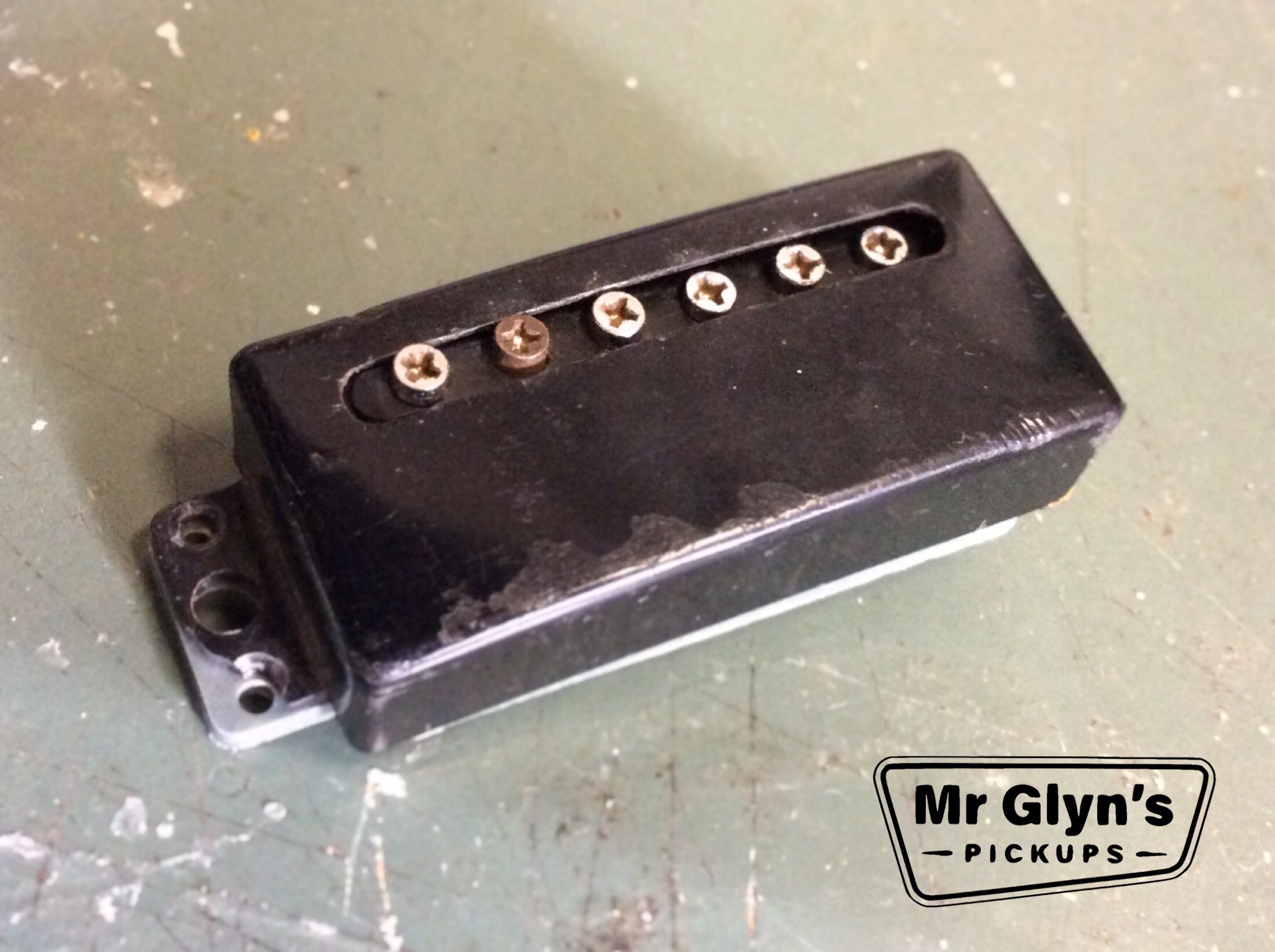
Yamaha SA30 pickup

Vintage Yamaha humbucker

This Yamaha SA30 pickup came to me for repair the other day and I decided to take some photos and share my thoughts on it with you.

Yamaha SA30 pickup - Mr Glyns Pickups

Yamaha SA30 pickup

The Yamaha SA30 pickup is becoming a bit of a legend and getting rather sought after. Gone are the days you could pick one up cheap – the word is out. Thank you internet 🥴.

If you don’t know about them here’s some info: https://tymguitars.com.au/blogs/blog/1966-yamaha-sa-30t

The Repair

This Yamaha SA30 pickup was sent to me with an intermittent fault. It would work if you tapped it but stop a minute later. That pointed towards it being an internal wiring fault, maybe a dry joint, rather than a broken coil, I needed to investigate.

Yamaha SA30 pickup - Mr Glyns Pickups

With the cover off you can see the hook up wires – these were my number one suspects. Sure enough, there was a dry joint where one of them was soldered to the connectors on the base plate. Just to make sure I re- soldered all the joints and the pickup is fixed. It is pretty common for pickups to just have dry joint problems. Most of the pickups I receive for repair don’t need re winding.

What’s inside a Yamaha SA30 pickup?

But that’s not the interesting part – look at those bobbins. They’re different sizes. They each measure in the 4.5 K Ohms range but they’re clearly wound with different gauge wire on each coil. These pickups are renowned for their clarity – so what’s going on?

The smaller coil on the left must be wound with thinner gauge wire and less of it than the one on the right. Thinner wire have a greater resistance for the same length.

The coil on the right looks like a conventional humbucker coil like an overwound PAF but the coil on the left would have a less full sound. It will have less bottom and lower mids and a lot less power. But that’s just the windings. The windings are only ever half the story.

bobbins - Mr Glyns Pickups

Turn the pickup over and you can see a ceramic bar magnet but it’s how it connects to the poles that’s interesting. The bigger coil has a larger piece of steel coupling the poles to the magnet than the smaller coil. Measuring the strength of the magnetic field on the top of the poles the smaller coil is about 20% weaker. So this again gives the big coil an overwound PAF sound and the smaller coil still thinner.

 - Mr Glyns Pickups

So with the Yamaha SA30 pickup they’ve created that clarity by having one coil doing most of the work – 4.5k Ohms with a ceramic magnet has a bit more grunt than one half of a PAF. But the other coil on it’s own would have more of a weedy gold foil type sound. Then they’ve been combined in series as a humbucker. Smart stuff eh!

I find it fascinating how many variations there are of electric guitar pickups. They might just be a magnet and a coil of wire but there are so many ways to vary that basic plan. I’m not sure if i will ever incorporate this idea into one of my own pickups but it’s worth keeping at the back of my mind, you never know…

Feel free to contact me for pickup repairs or for a chat about my range of new pickups. mrglynspickups@gmail.com

And here’s a great site for all things Yamaha SA, heaps of information here https://www.thesupposedstringmeister.net/?page_id=644

https://mrglynspickups.com/

https://www.youtube.com/c/MrGlynsPickups/videos

Enjoy this? You may also like…

Mr Glyns Pickups  Roboguy Logo

Posted on 1 Comment

‘78 Musicman Stingray Bass pickup re-wind

Musicman Stingray bass pickup

The Musicman Stingray bass is for me one of the top 3 basses ever. the Precision, the Jazz and the Stingray cover pretty much everything between them. A big part of what makes the Stingray so good is the Musicman Stingray Bass pickup.

It has such a distinctive sound. Once you’re tuned into it you can hear it on so many recordings.

This pickup is from 1978 (they started in 1976) and was sent to me from a customer in Christchurch. I thought I’d show you around inside it – these are really interesting pickups.

Music Man Stingray bass pickup
‘78 Musicman Stingray Bass pickup

The Musicman Stingray Bass pickup is by the look of it a big fat humbucker but there’s more to it.

Description of the Musicman Stingray bass Pickup

The magnets are big alnicoV’s, 3/8” diameter and 5/8” deep. They produce a lot of the power and that grunt comes from them. The 2 coils are wound with awg 42 wire and are around 4KOhms each (they vary). The poles on each coil have opposite polarity and the coils are wired out of phase electrically so they act as a humbucker. The really interesting part is the coils are wired in parallel, not in series like most humbuckers.

The sound of 2 coils in parallel is the sound of a Jazz bass with both pickups on or a Strat on switch position 2 or 4. It’s a very distinctive, clear tone with a very clear midrange and chimney bass.

So the distinctive Stingray sound comprises of fairly low powered coils in parallel to give plenty of clarity but with exceptionally fat magnets to give bass and grunty mids.

I haven’t mentioned the active circuit the signal goes through yet but that’s another story.

Music Man Stingray bass pickup, cover off
‘78 Musicman Stingray Bass pickup

A look inside

As you can see, under the cover it looks very similar to ‘Fender’ pickups.

Music Man Stingray bass pickup
‘78 Musicman Stingray Bass pickup

One coil was open circuit so I cut the windings out. There was tape wrapped around the magnets to protect the coil. I left that in. I love the way they staggered the pole pieces but kept the magnets the same size.

Music Man Stingray bass pickup repair
pickup re-wind

The original winding wire is insulated with red poly. Unfortunately I only had Poly insulation in the natural colour – that’s my coil on the right.

Music Man Stingray bass pickup
MusicMan Stingray Pickup

And there she is, all ready to go back in to the bass. https://mrglynspickups.com/

If anyone has a faulty pickup just give me a call 021912678 or email mrglynspickups@gmail.com

Take a look at my YouTube series “Mr Glyn Meets Your Maker” where I have chat with manufacturers of musical gear from around New Zealand https://www.youtube.com/channel/UCcDggiRTQyFec5KAVHsC2xA

Enjoy this? You may also like…

Posted on 2 Comments

Fender Wide Range humbucker

There’s a lot talked about the original Fender Wide Range humbucker especially now with Fender re-introducing these classics with vintage correct CuNiFe magnets.

For the full back story on what makes these magnets so important here’s a great interview on my favorite podcast with the man who brought CuNiFe back, Tim Shaw.

The Fender Wide Range humbucker was the invention of Seth Lover. He’d previously worked at Gibson and is responsible for the PAF Humbucker

In 1967 he went to work for Fender and was asked to make an equivalent to the PAF to compete with Gibson. He was still obliged under the PAF copyright (even though it was under his own name) to make something completely different and that’s what he did.

Original 1975 wide range humbucker - Mr Glyns Pickups

So why CuNiFe ?

Fender guitars are known for their percussive treble. A bit part of which is achieved by having the magnet located inside the coil unlike Gibson style pickups with the magnet outside. He was clearly keen to have adjustable poles too so that left the question of – how do I make magnetic threaded bar? The answer is CuNiFe. Other magnetic material needs to be cast where as CuNiFe – an alloy of copper (Cu), nickel (Ni), iron (Fe) – can be machined.

The primary use for CuNiFe at the time was in speedometers where this threaded magnet was used in calibration. But when the automotive industry moved on to better methods of measuring speed CuNiFe stopped being produced. So the traditional Wide Range ceased production in 1979. The re-introduced Wide Range humbuckers of the 1980’s have a Gibson PAF style bar magnet underneath the coils. They might look like Wide Ranges but they really aren’t.

Why is the Fender Wide Range humbucker so big?

CuNiFe does not make strong magnets and has quite a trebly tone. To offset this Seth needed to design powerful coils. The more windings on a bobbin the more power but also the more bass and less treble. The whole eq is shifted to the bass side. Compered to a PAF the Wide Range coils are very overwound. So much so the bobbins had to be made bigger to accommodate them and therefore the whole pickup is bigger. Wide Ranges are wound to around 10.6KOhms where as a traditional humbucker is closer to 8KOhms.

Then there’s the much ignored steel plate under the coils. Putting a steel plate under a magnet will help push the magnetic field up towards the strings creating a bit more power and a bit more bass. This works in the same way as in my Tui pickup – here’s more on that.

The result of all this is a clear, full sounding pickup loved by many.

Interesting eh.

Repairing a Wide Range

A while ago I had a faulty Fender Wide Range humbucker sent to me for repair and took the chance to take some pictures. This one is from 1975 as you can see from the last 2 digits of the serial number. From the underneath you can also see the sneaky way he used the threaded magnets fitting half of the upside-down.

1975 Wide Range base plate

With the cover off we get a good look at these unique bobbins. There’s a small metal tab at each end of them to help with connecting the winding wire with the hookup wire.

Wide Range bobbins - 1975

With one bobbin removed there’s that steel plate underneath directing the magnetic field and adding inductance to the coils. The black wire connects the 2 coils together in series and it’s tucked away between the coils when the pickup is together.

Original Wide Range repair

You can see that even though this is an oversized bobbin it’s full up with wire.

Fender Wide Range humbucker

Here’s a really interesting blog post on a Wide Range copy by Tym Guitars in Australia. You can see the difference between an original Fender Wide Range humbucker and what looks like an exact replica.

Roboguy Logo

Fender Wide Range humbucker

Enjoy this? You may also like…

updated 3 April 2023

Posted on Leave a comment

Telecaster Elite ‘83 bridge pickup

I was sent an interesting faulty pickup the other day. It’s a bridge pickup from a 1983 Fender Telecaster Elite. Fender did a few unconventional things around that time and this is one of them.

Overview

The Telecaster Elite pickup is an unusual shape which means that it’s not an easy pickup to replace so I really needed to save this one.

Telecaster Elite pickup
Telecaster Elite ‘83 bridge pickup

What’s inside a Telecaster Elite pickup

Inside the plastic cover is a humbucker encased in some sort of resin. At least one of the coils is faulty so will needs to be re-wound. This resin is great until there’s a problem, I just had to dig the bobbins out. There was no way the coils were coming out undamaged so I gave the customer a call to explain they both needed re-winding. He was happy so I got on with it.

Tele Elite pickup bottom
Telecaster Elite ‘83 bridge pickup
Tele '83 elite
Telecaster Elite ‘83 bridge pickup
Elite Tele'83
Telecaster Elite ‘83 bridge pickup

It’s a pretty delicate operation to get the coils out without damaging them.

'83 Elite Tele pickup repair
Telecaster Elite ‘83 bridge pickup
Telecaster Elite pickup bobbins
Telecaster Elite ‘83 bridge pickup

Spec

Once they were out and cleaned up it was a straightforward re-wind. I matched the dc resistance to the original spec of 11.3KOhms and put it all back.

1983 Telecaster Elite pickup
Telecaster Elite ‘83 bridge pickup
Telecaster Elite Pickup 1983
Telecaster Elite ‘83 bridge pickup

If you have any duff pickups, get in touch. Most old pickups can be saved.

Pickup re-winds are a big part of what I do.

In the early days back in the 1990’s I re-wound a lot of pickups. It was an invaluable introduction into the inner workings of electric guitar pickups.

Back then there were a lot of 60’s and 70’s quality pickups around to practice on, they weren’t as valuable or sought after as they are now. Because of that I got to see how pickups were put together in the old days, the construction, the potting material…

There wasn’t much information available so experimentation was the only way to learn. I made so many bad pickups back then but made a note of every single one, how I’d wound it and what the result was. By using that method I got closer and closer to what I wanted. I also made a note of all the re-winds I did and the original spec if I could get it. I’m still writing in that note book to this day and it’s becoming a fantastic reference tool when I receive an unusual pickup repair from a customer.

I still really enjoy re-winding pickups, I think I have a strong instinct to fix things. I would much rather repair a faulty old pickup than sell a customer a new one. Sometimes, of course, the customer wants a different sound that the old pickup can’t give them and a new pickup is the way to go.

Please feel free to contact me about any faulty pickup by email (mrglynspickups@gmail.com) or by phone (021 912 678). https://mrglynspickups.com/

https://www.youtube.com/channel/UCcDggiRTQyFec5KAVHsC2xA

Enjoy this? You may also like…

updated 3 April 2023

Posted on Leave a comment

Seymour Duncan JB Re-Wind

Seymour Duncan JB humbuckers are such a classic pickup, loud and aggressive with no shortage of high end attack. This particular one has had a hard life and finally gave up so it arrived at my workshop for repair. It’s not the first Duncan JB Re-Wind I’ve had to do but this time I’ve taken some pics.

Seymour Duncan JB repair
Duncan JB

This one had stopped working altogether. With the tape off the hook up wires are exposed and it’s possible to identify which coil has the problem. It’s usually just one coil.

Mr Glyns Pickups repairing a JB

It turned out to be the coil with the screws in this case.

Duncan JB repair

The coil with the lugs in fine and showing 8.42KOhms and from that I can figure out what size wire they used and calculate the number of turns needed to re-wind the duff coil.

Pretty routine stuff this Duncan JB Re-Wind but always nice to have a look inside a classic pickup. https://mrglynspickups.com/

https://www.youtube.com/channel/UCcDggiRTQyFec5KAVHsC2xA

Pickup re-winds are a big part of what I do.

Enjoy this? You may also be interested in…